How to Plan a Commercial Concrete Project in the Black Hills
2025 Guide | WagCo Construction
Commercial concrete projects in the Black Hills—from foundations and slabs to pads, approaches, and site flatwork—require a higher level of planning than many owners realize. The region’s climate, soil conditions, elevation changes, and engineering requirements make precise concrete planning essential for long-term durability.
Whether you’re developing a new commercial building, expanding a warehouse, pouring a structural slab, or installing parking and access drives, your concrete is the structural backbone of the entire project.
This guide walks you through everything business owners, developers, and facility managers need to know when planning a commercial concrete project in the Black Hills.
Why the Black Hills Region Requires Specialized Concrete Planning
Concrete behaves differently in the Black Hills than in many other parts of the country. A combination of freeze–thaw cycles, expansive soils, elevation shifts, strong winds, and regional engineering standards means your concrete installation must be handled by a contractor who understands local conditions.
Key regional challenges include:
- Harsh winters with repeated freeze–thaw cycles
- Soil variation between Box Elder, Piedmont, Rapid City, Black Hawk, and Spearfish
- High winds and uplift forces that affect slab and footing design
- Variable water tables depending on elevation
- Slope and drainage challenges in hill areas
- Heavy equipment loads in industrial and commercial zones
Doing concrete “the standard way” simply doesn’t cut it here—Black Hills projects require correct reinforcement, jointing, subgrade compaction, and curing processes to avoid cracking, heaving, and premature failure.
Step 1: Define the Scope and Purpose of the Concrete Work
Every commercial concrete project begins with clearly defining what the slab or structure will support.
Common types of concrete work in the Black Hills include:
Structural Slabs
- Commercial buildings
- Warehouses
- Retail spaces
- Restaurants
- Office expansions
Industrial Slabs & Heavy-Load Areas
- Shops with vehicle lifts
- Equipment pads
- Forklift or heavy-load traffic
- Wash bays
Site & Exterior Flatwork
- Approaches
- ADA ramps
- Sidewalks
- Parking stalls
- Loading dock areas
Foundations & Footings
- Grade beams
- Frost walls
- Stem walls
- Pier foundations
Each slab type requires its own:
- Thickness
- Reinforcement pattern
- Subbase prep
- Vapor barrier
- Joint layout
- Curing process
You should talk through all intended uses with your contractor before design begins.
Step 2: Assess Site Conditions in the Black Hills
Site conditions dramatically affect concrete planning—and costs. In the Black Hills, the biggest factors are:
1. Soil Conditions
Soils range from compact, stable gravels to loose fill, clay-heavy soils, or fractured limestone regions. The subbase determines:
- Required compaction
- Need for over-excavation
- Reinforcement needs
- Potential for slab movement
In areas like Piedmont, Sturgis, and Spearfish, fractured rock and slope variations can influence excavation requirements.
2. Drainage & Water Flow
A slab is only as stable as the water management around it.
Improper drainage causes:
- Slab heaving
- Edge scaling
- Erosion
- Frost movement
Your contractor must evaluate grading and incorporate:
- Proper slope away from structures
- Drain tile if necessary
- Engineered downspout control
- Correct trenching for utilities
3. Weather Exposure
Concrete poured at high elevations or exposed plains areas (e.g., Box Elder, Ellsworth AFB region) must be engineered to resist:
- Higher winds
- Temperature swings
- Winter exposure
Planning around weather dramatically improves outcomes and prevents cracking or surface failure.
Step 3: Determine Engineering Requirements
Commercial concrete engineering is not optional—it’s essential.
In the Black Hills, most commercial slabs require:
✔ Structural engineering
Load calculations, rebar layout, slab thickness, and joint spacing.
✔ Frost-depth considerations
South Dakota frost depth can reach 48 inches or more, depending on municipality.
✔ Reinforcement design
For industrial or heavy-use slabs, structural rebar, thicker concrete, and higher PSI mixes are required.
✔ Vapor & moisture control
Especially for interior slabs, commercial buildings, and retail spaces.
✔ Expansion joint design
Particularly critical in high-movement or large-area slabs.
WagCo Construction works with local engineers experienced in Black Hills conditions to ensure the slab is built to handle your actual needs—not guesswork.
Step 4: Choose the Appropriate Concrete Mix
Concrete mix selection affects long-term durability, cracking, and strength. For commercial projects, mixes commonly include:
- 4000 PSI standard commercial
- 4500–5000 PSI for heavy load areas
- Air-entrained concrete for freeze–thaw resilience
- Fiber-reinforced mixes for added tensile strength
- Accelerated mixes for cold-weather curing
- High-strength mixes for structural components
Choosing the wrong mix leads to scaling, spalling, or premature cracking—especially in exterior slabs subjected to Black Hills winters.
Step 5: Plan for Subgrade Preparation
Subgrade preparation is one of the most important—and most often overlooked—parts of commercial concrete preparation.
Proper subgrade includes:
1. Over-Excavation (If Needed)
Removing unsuitable soils to reach stable ground.
2. Compaction
Local requirements often specify 95% compaction minimum for commercial slabs.
3. Base Material
Typically:
- Crushed gravel or
- Road base (Class 5 or Class 6)
4. Moisture Control
Correct moisture content ensures compaction and stabilization.
A perfect slab poured over a poor subbase will not survive South Dakota winters. This step must be executed correctly.
Step 6: Reinforcement, Joints & Layout
The structural integrity of commercial slabs depends heavily on reinforcement and joints.
Reinforcement Options
- #4 or #5 rebar grid
- Wire mesh (less common for commercial now)
- Fiber reinforcement
- Double-mat reinforcement for heavy-load slabs
Jointing
Joint layout controls where cracks happen:
- Control joints (sawn or tooled)
- Expansion joints at walls and transitions
- Isolation joints around posts, columns, plumbing, and foundations
Incorrect joint spacing is one of the top causes of random cracking.
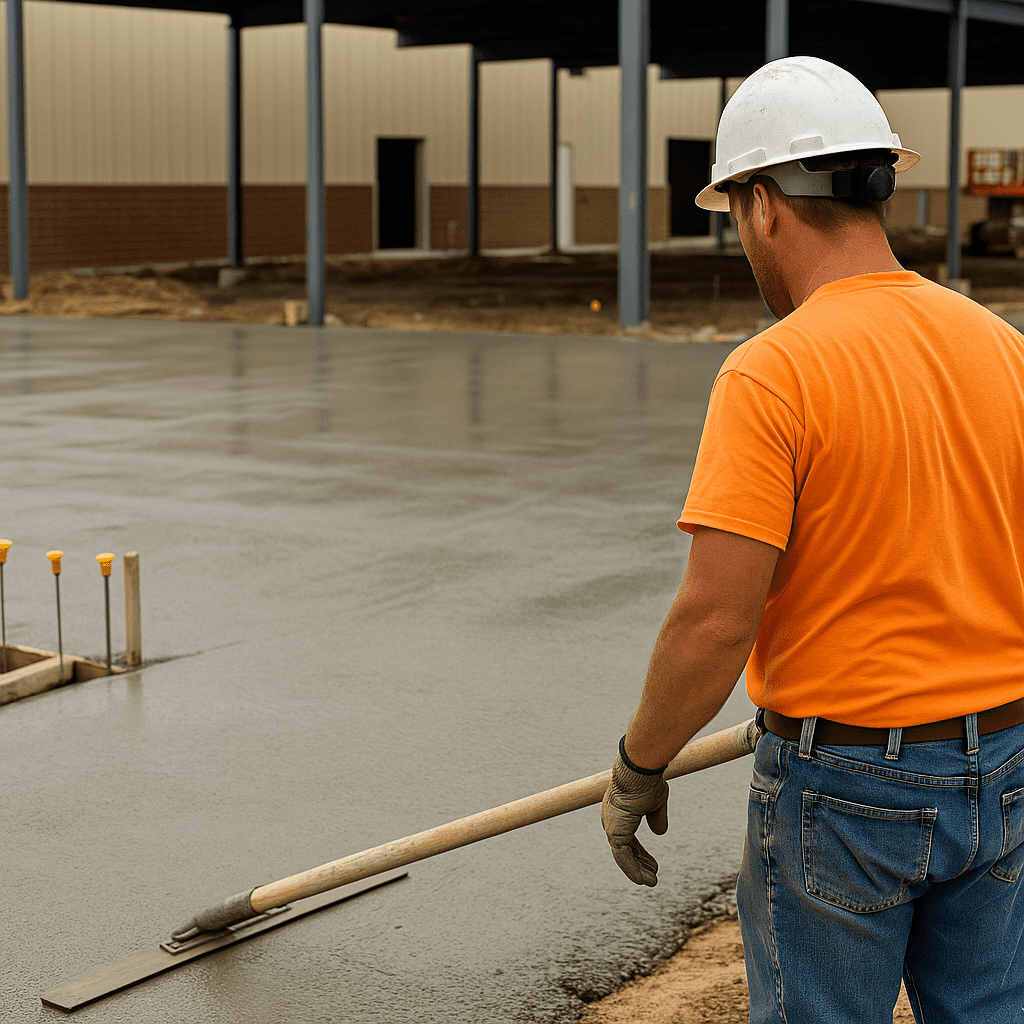
Step 7: Pouring & Finishing
Concrete finishing must match the slab’s intended use:
Common Commercial Finishes
- Hard trowel for interior slabs
- Broom finish for sidewalks and approaches
- Non-slip finishes for ADA ramps
- Polished concrete for retail or office interiors
- Industrial finishes for warehouses
Timing is everything. Concrete must be poured and cured according to environmental conditions—the Black Hills climate requires a high level of expertise here.
Step 8: Curing & Protection
Curing affects:
- Strength
- Durability
- Surface quality
- Long-term performance
In this region, extra care must be taken to protect young concrete from:
- Freezing temperatures
- Dry, hot winds
- Direct sun
- Excess moisture loss
Methods include:
- Water curing
- Curing compounds
- Blankets & insulated covers
- Heated enclosures during winter
Skipping proper curing can reduce slab lifespan by up to 50%.
Step 9: Scheduling Around Black Hills Weather
Weather timing is crucial:
Best months for major exterior pours:
May – October
Challenging months:
November – April
Cold-weather pours require:
- Accelerators
- Heated tents
- Ground thawing
- Thermal blankets
- Special mixes
Pouring during winter is possible—but only with proper planning and protections.
Step 10: Choosing the Right Contractor
A commercial concrete project in the Black Hills should only be trusted to a contractor who:
- Self-performs concrete
- Understands regional soil & weather
- Coordinates with engineers
- Provides detailed joint & reinforcement layouts
- Has proven experience with commercial slabs
- Knows local code, inspection, and permitting requirements
WagCo Construction self-performs commercial concrete throughout the Black Hills, ensuring better quality control, faster timelines, and tighter coordination.
Final Tips for Planning Your Project
✔ Start early
Design, engineering, and permitting often take longer than expected.
✔ Budget correctly
Commercial concrete varies widely in cost depending on use, thickness, and reinforcement.
✔ Don’t cut corners on subgrade
It’s the hidden part of the slab — but the most critical.
✔ Make decisions based on real load requirements
If forklifts or machinery are involved, the slab must be engineered accordingly.
✔ Work with a contractor who knows the region
Black Hills concrete requires local expertise.
Ready to Plan Your Commercial Concrete Project?
Whether you’re planning a foundation, an industrial slab, site flatwork, a commercial addition, or a new building, WagCo Construction provides precise, reliable, and locally experienced commercial concrete services throughout the Black Hills.
👉 Request a Quote: https://wagcoconstruction.com/get-a-quote/
👉 Call: 605-786-7213
👉 Contact: https://wagcoconstruction.com/contact/
WagCo Construction
Your Black Hills Commercial Concrete Partner