
Warehouse & Shop Floors in South Dakota: Concrete Specs That Prevent Dusting, Cracking, and Forklift Damage
Warehouse and shop floors don’t fail loudly at first. They fail quietly. A little dust shows up near traffic lanes. Hairline cracks widen where forklifts turn. Joints start to chip. Over time, those “minor” issues turn into damaged product, higher maintenance costs, safety concerns, and expensive downtime.
In South Dakota, industrial concrete floors face a tough combination: heavy loads, tight turning radii, temperature swings, and moisture that can migrate up from below the slab if it isn’t properly designed. The good news is that most warehouse and shop floor problems are preventable when the slab is specified correctly from the start.
This post breaks down what actually matters for warehouse and shop floors in South Dakota—without overengineering, without fluff, and with a focus on performance, readability, and long-term value.
Why warehouse floors fail differently than parking lots or sidewalks
Warehouse floors are interior slabs, but they behave differently than people expect. They’re subjected to repetitive point loads from forklifts, pallet jacks, racking systems, and equipment. Unlike exterior flatwork, failures here often show up as dusting, joint breakdown, and surface wear rather than dramatic cracking.
Another difference is moisture. Even interior slabs can suffer from moisture-related issues if vapor barriers are missing or improperly installed. Moisture moving up through the slab can weaken the surface, contribute to dusting, and interfere with coatings or sealers later.
In South Dakota, temperature swings can still affect interior slabs during construction, especially in large metal buildings or partially enclosed spaces. Cold weather placement, curing conditions, and protection still matter—even when the slab is technically “inside.”
Thickness and load planning: forklifts change everything
Warehouse floor thickness isn’t about square footage—it’s about loads. A floor designed for light storage will not perform the same as a floor designed for constant forklift traffic and heavy palletized goods.
Forklifts create high point loads, especially under small wheels and during turning. That stress concentrates at joints and slab edges. If thickness is underestimated, you’ll see cracking, joint faulting, and edge spalling much earlier than expected.
In South Dakota warehouses, it’s common to see slabs designed with thicker sections in traffic lanes and loading areas, with lighter sections in low-use storage zones. This approach balances cost and performance, but only if traffic patterns are known and planned in advance.
If you’re building a shop or warehouse, the most important question to answer early is simple: what will drive on this floor, how often, and with how much weight?
Subgrade and base: the unseen system that carries the load
Industrial slabs rely heavily on what’s underneath them. A warehouse floor that looks perfect on day one can still fail if the subgrade and base aren’t uniform and stable.
Subgrade needs to be consistent across the entire slab area. Soft zones, old utility trenches, or variable moisture conditions create differential support that leads to cracking and movement. Base material spreads loads and reduces stress concentrations, which is critical under forklifts.
In South Dakota, moisture management under slabs is especially important. A base that holds water or isn’t properly compacted can pump fines under repeated loading. That pumping accelerates joint breakdown and slab movement.
A well-prepared base doesn’t just support the slab—it protects it from long-term fatigue.
Vapor barriers: one of the most skipped and regretted details
Moisture vapor coming up through a slab can cause problems even when the slab never gets wet from above. This is a major issue in warehouses where dusting, coating failures, or condensation appear unexpectedly.
A proper vapor barrier below the slab helps prevent moisture migration. This matters more if the space will be climate controlled, if coatings or sealers will be applied, or if stored goods are sensitive to moisture.
Skipping or downgrading vapor barriers is a short-term cost savings that can create long-term headaches. Once a slab is poured, adding vapor protection is no longer an option.
Joint layout: the difference between controlled cracks and constant repairs
Joints are unavoidable in large warehouse slabs. The goal is to place them where they manage cracking and minimize impact on operations.
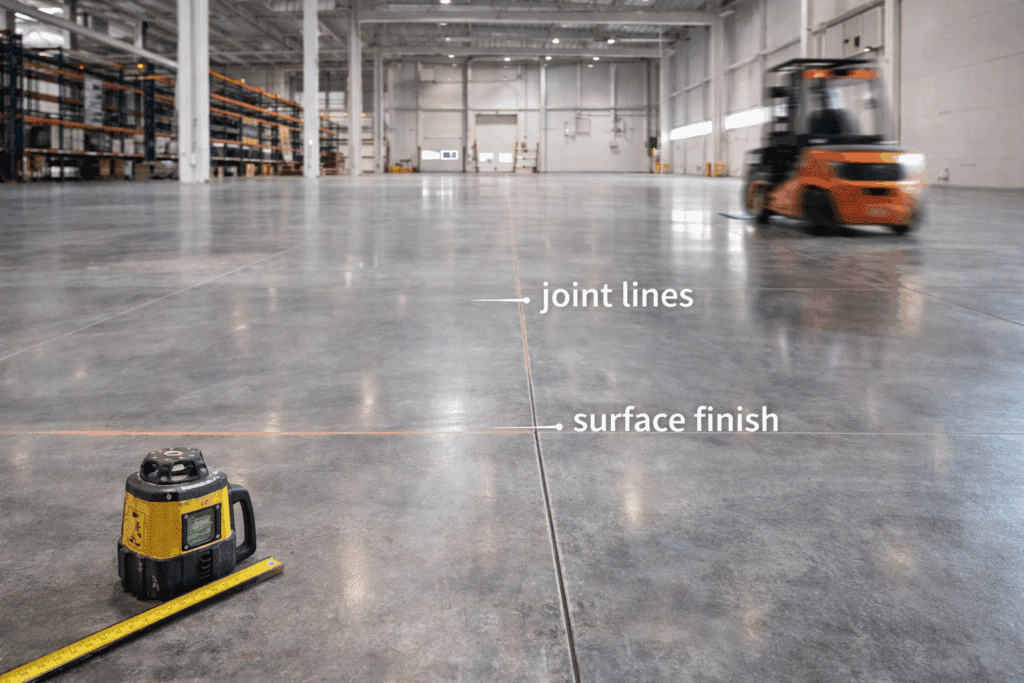
Poor joint spacing or layout leads to random cracking or joints that take too much abuse from forklifts. When joints are too far apart, cracks form unpredictably. When joints are placed without considering traffic flow, forklift wheels hit the same joint edges repeatedly, accelerating spalling.
In warehouses, joint planning should consider rack layout, traffic lanes, and turning areas. Aligning joints with racking rows or minimizing crossings in high-traffic areas can significantly reduce wear.
In South Dakota, temperature-related movement during curing and early slab life makes joint timing and placement even more important.
Concrete mix and surface durability: preventing dusting before it starts
Concrete dusting is one of the most common complaints in warehouses. It shows up as a fine powder on the surface that never seems to go away.
Dusting usually points to surface weakness. Causes can include improper finishing, excess water at the surface, poor curing, or an inappropriate mix design. In cold or dry conditions, the surface can dry too quickly, preventing proper hydration and leaving a weak wear layer.
A durable warehouse floor starts with the right mix and disciplined finishing. That means no adding water to “help” the finish, proper timing during finishing, and curing that protects the surface during early strength gain.
In some cases, surface hardeners or densifiers are used to increase abrasion resistance. These need to be applied correctly and at the right time to be effective.
Finishing and flatness: performance matters more than looks
Warehouse floors don’t need to be pretty. They need to be flat, durable, and functional.
Flatness affects forklift stability, racking performance, and operator safety. In facilities with high racking or automated systems, floor flatness becomes even more critical.
Finishing methods should support durability and flatness, not just appearance. Over-troweling or rushing finishing can weaken the surface. Finishing needs to be matched to the size of the pour, environmental conditions, and performance requirements.
Large South Dakota warehouse pours often require careful planning to manage temperature, wind, and curing conditions, especially in shoulder seasons.
Curing and protection: interior slabs still need it
It’s a mistake to assume interior slabs don’t need curing protection. Large buildings often act like wind tunnels during construction, drying surfaces too quickly. Cold weather can slow hydration or damage young concrete.
Proper curing improves surface hardness, reduces dusting, and supports long-term strength. Whether curing is done with compounds, coverings, or controlled conditions, it needs to be part of the plan—not an afterthought.
In South Dakota, curing during fall and winter construction often requires extra coordination to prevent early damage that shows up months later.
Planning for future use saves money
One of the biggest regrets owners have with warehouse floors is not planning for future loads. A slab designed for light storage might not perform when heavier equipment or different operations move in later.
Upgrading slab performance later is expensive and disruptive. Planning for realistic future use—within reason—can be far more cost-effective during initial construction.
That doesn’t mean overbuilding blindly. It means understanding how the space might evolve and designing the slab system to handle it.
What to look for in a warehouse concrete floor scope
A solid scope for a South Dakota warehouse or shop floor should clearly address slab thickness, base preparation, vapor barrier inclusion, joint layout approach, finishing method, curing plan, and performance expectations. It should also reflect traffic types and loads rather than generic assumptions.
If these items aren’t discussed, the floor may still get poured—but performance becomes a gamble.
The bottom line: industrial floors fail slowly, then expensively
Warehouse and shop floors don’t usually collapse. They slowly become harder to work on, harder to maintain, and more expensive to fix. Most of those problems trace back to decisions made before the concrete was ever poured.
If you’re planning a warehouse or shop floor in South Dakota, WagCo Construction can help you design a slab system that matches your operations, handles forklift traffic, resists dusting, and performs for the long haul—without overbuilding or cutting corners.