
ADA Concrete Compliance in South Dakota: Ramps, Slopes, Landings, and the Costly Mistakes to Avoid
ADA compliance is one of the fastest ways a commercial concrete project can go from “done” to “redo it.” And the frustrating part is that many ADA issues don’t look wrong to the naked eye. A ramp can appear smooth and professional and still fail because the slope is slightly too steep, the cross-slope is off, the landing isn’t sized correctly, or a transition creates a trip hazard.
In South Dakota, ADA concrete work shows up everywhere—sidewalks, building entries, ramps, curb ramps, accessible routes through parking lots, and transitions between asphalt and concrete. If you’re a business owner, property manager, or developer, ADA compliance protects you from more than just inspection headaches. It helps prevent injuries, improves accessibility for customers and tenants, and avoids expensive tear-out and replacement.
This post explains ADA-related concrete requirements in plain language, highlights the most common mistakes we see on commercial sites, and shows you what to look for so your project passes the first time.
ADA concrete isn’t a “feature”—it’s part of the building’s usability
A lot of owners treat ADA work like a box to check at the end. But accessible routes are a core part of how a property functions. If someone can’t get from an accessible parking space to the entry without struggling, the site isn’t doing what it’s supposed to do.
ADA compliance is also about consistency. A single out-of-spec ramp section or a poorly sloped landing can create a pinch point that makes the whole route non-compliant. That’s why ADA concrete needs planning early, not as a last-minute add-on during finishing.
The slope issues that cause most failures
The easiest way to understand ADA concrete problems is this: slopes and transitions are where jobs fail. Even a small deviation can create a non-compliant path.
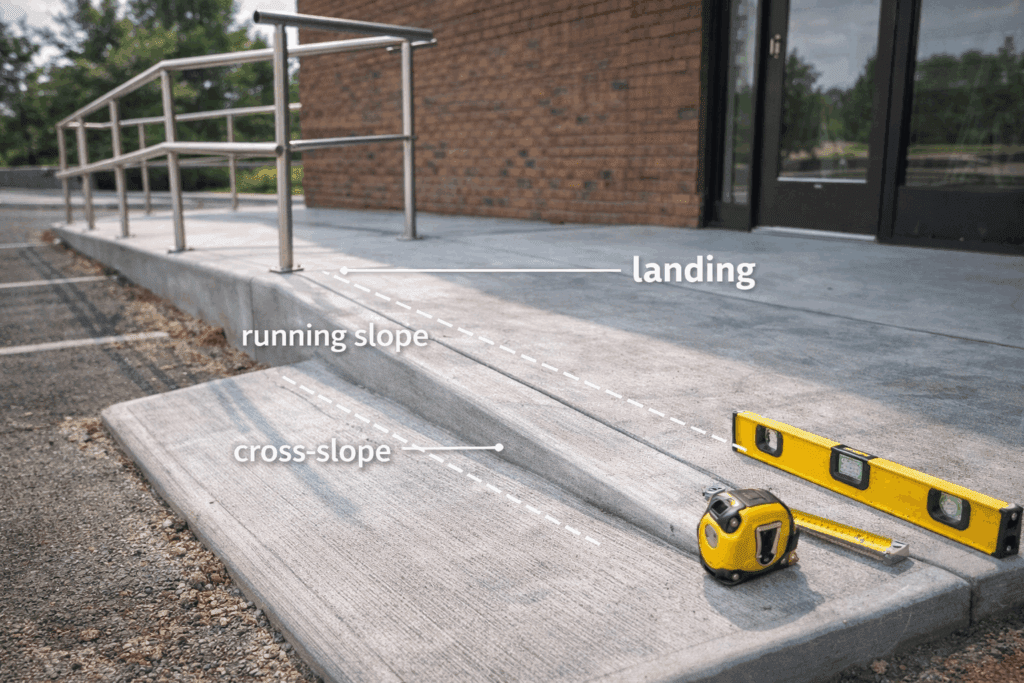
Running slope is the slope in the direction of travel. This matters most on ramps, but it also matters on sidewalks and access routes in general. Cross-slope is the side-to-side slope. Cross-slope is a big deal because it affects stability for wheelchairs, walkers, and anyone with mobility limitations.
On many commercial projects, cross-slope errors happen because crews focus on moving water and forget how sensitive accessible routes are to side-to-side tilt. Drainage matters, but accessible routes require careful layout so you get both drainage and compliance.
The other major slope issue is unintended slope created during transitions—where concrete meets asphalt, where slabs meet at door thresholds, or where curb ramps tie into gutter lines. Those transition areas often look minor but can cause major compliance problems.
Landings are where accessibility succeeds or fails
Landings sound simple: a flat area at the top or bottom of a ramp, or in front of a door. In practice, landings are one of the most common failure points because they’re affected by everything around them—door swing clearances, threshold elevations, nearby grades, and drainage paths.
A landing needs to function for real use. Someone needs to be able to stop safely, turn if needed, and open a door without fighting a slope that pushes them sideways. If the landing is too small, too sloped, or cluttered by obstructions, it becomes a usability problem even if the ramp itself looks fine.
On South Dakota sites, landings are also exposed to ice. If landings are designed in a way that traps water or forces ponding, they become slippery and dangerous. Good planning avoids creating a “flat bowl” where meltwater sits.
Curb ramps and detectable warnings: small details, big consequences
Parking lots and sidewalks often require curb ramps to connect accessible parking spaces to accessible routes. Curb ramps are technical because they sit at the intersection of sidewalk slope, curb height, gutter flow, and vehicle drainage patterns.
A curb ramp that’s too steep, too narrow, or poorly aligned can be non-compliant. A curb ramp that creates ponding or directs water onto the route creates an ice risk. A curb ramp that doesn’t match the travel path forces awkward maneuvers for wheelchairs and strollers.
Detectable warning panels (the textured “truncated dome” surfaces) are another detail that’s easy to treat like a last-minute add-on. But placement matters, alignment matters, and installation quality matters. If they’re placed wrong, poorly adhered, or installed on a surface that isn’t prepared properly, they can fail over time and become a maintenance issue.
Common ADA concrete mistakes on commercial sites in South Dakota
The most expensive ADA mistakes are the ones that require removal and replacement. These happen more often than owners realize, usually because the job was rushed or because ADA measurements weren’t verified during construction.
One common issue is “almost compliant” slope. A ramp is poured slightly steeper than allowed, or a sidewalk has just enough cross-slope that it becomes a problem. It doesn’t look wrong, but it fails when measured.
Another issue is inconsistent slopes across a route. One section is good, but a transition at the end of a slab is off. Or a curb ramp ties in incorrectly. Or the route crosses a driveway apron and the slope changes in a way that creates a non-compliant segment.
Door landings are also frequent failure points. The landing might look flat, but the slope near the doorway, the threshold transition, or the door clearance area doesn’t meet requirements.
Then there are drainage-driven mistakes. Crews may add slope to move water quickly, but they unintentionally push the accessible route out of spec. The right answer is usually a plan that balances grading and compliance rather than improvising in the field.
ADA concrete and winter performance go together
Compliance is one piece. Real-world performance is another.
In South Dakota, an ADA route that becomes an ice sheet every winter is a functional failure even if the slope technically passes. That’s why proper drainage and thoughtful grading are part of accessibility. Water should move away from entrances, away from landings, and away from curb ramps so ice doesn’t repeatedly form where people have to travel.
Traction matters too. Exterior ADA routes typically need a finish that provides grip. Smooth finishes can become dangerous when wet or icy. A good finish choice supports both accessibility and safety.
How to make ADA concrete easier and less stressful for owners
The easiest way to avoid ADA rework is to plan it early and measure it during construction. That means routes are laid out intentionally, not guessed. It means grades are verified before pouring. It means formwork is checked for slope and alignment, not just for “looks good.”
It also means choosing a contractor who treats ADA like a priority, not an inconvenience. The best commercial teams build measurement and verification into their process so the project doesn’t rely on hope.
If you’re an owner or manager, you don’t have to be the ADA expert. But you can protect yourself by requiring clarity: ask how the accessible route will be verified, how slopes will be checked, and who is responsible for compliance measurements. Those questions alone push the project toward a cleaner outcome.
What to look for in an ADA concrete bid or scope
A good scope should identify where ADA routes exist on your site—parking to entry, sidewalks, ramps, curb ramps, and transitions. It should reflect that those routes require special attention to slopes and landings. It should mention how measurements will be handled or verified, not just “we’ll pour ramps.”
You should also confirm how the project will handle transitions between materials and elevations. Many ADA problems are really transition problems: concrete to asphalt, slab to curb, ramp to gutter, sidewalk to entry. Those interfaces should be planned, not left to field improvisation.
The bottom line: ADA concrete is cheaper when it’s done right once
ADA compliance protects accessibility, safety, and your long-term budget. The costliest part of ADA work is almost never building it. It’s tearing it out and doing it again because slopes, landings, or transitions weren’t verified.
If you’re planning commercial concrete in South Dakota and your project includes sidewalks, entries, ramps, curb ramps, or parking lot access routes, WagCo Construction can help you build an ADA-compliant system that drains correctly, performs through winter, and passes without expensive rework.