
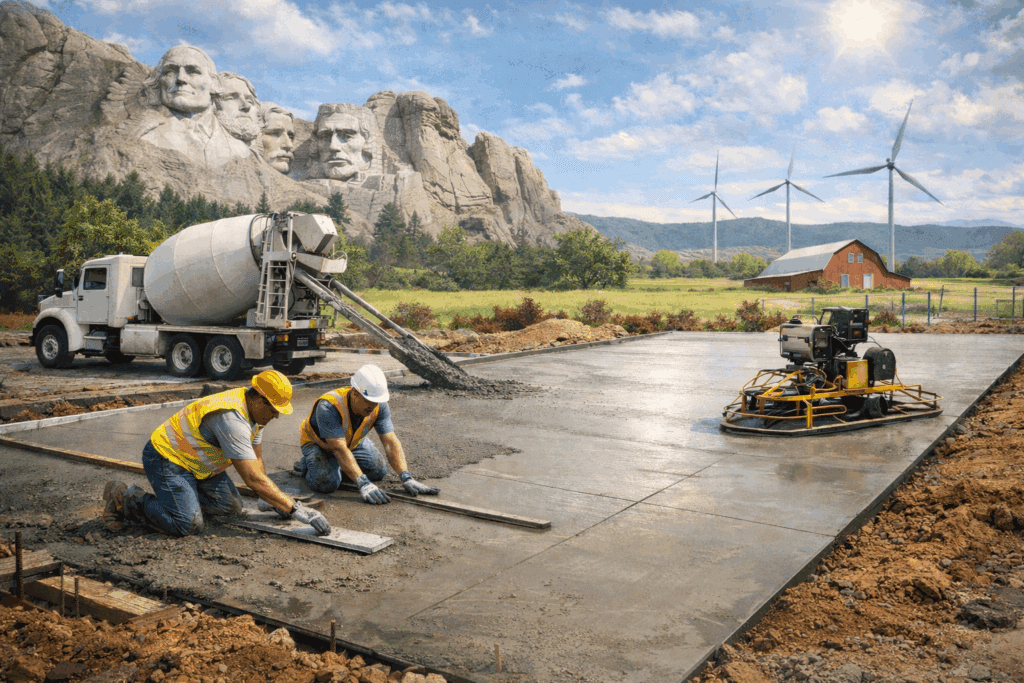
Commercial Concrete Flatwork in South Dakota (Cost Drivers + Best Practices)
Commercial concrete flatwork looks simple from the outside. It’s “just a slab,” right? Sidewalks, approaches, equipment pads, loading aprons, and parking lots all seem like the same thing until you start comparing bids. That’s when business owners notice something confusing: two proposals can appear similar and still be thousands of dollars apart.
Most of the time, that price gap isn’t about one contractor being greedy and the other being honest. It’s about what’s included in the system beneath the concrete, how the slab is engineered for real-world use, and how the pour is planned for South Dakota’s climate. Concrete flatwork is one of those scopes where the cheapest number can become the most expensive decision if it leads to premature cracking, settlement, ponding water, or surface scaling after a few winters.
If you’re planning a commercial project in South Dakota, this guide explains what actually drives cost and performance in flatwork so you can compare bids correctly and build something that lasts.
What “commercial flatwork” includes on South Dakota projects
Commercial concrete flatwork covers a wide range of areas, and each one demands a different approach. Sidewalks and storefront walkways need traction and clean finish lines, and they often tie into accessibility requirements. Parking lots and drive lanes deal with constant vehicle traffic, turning loads, and snow removal. Loading aprons and dumpster approaches see heavy trucks, repeated impact, and point loads that destroy underbuilt slabs. Equipment pads need stable support and correct drainage so they don’t turn into ice rinks or settle out of level over time.
When a bid is based on square footage alone, the quote is usually missing important details. The right way to price commercial flatwork is by use-case. Where will trucks turn? Where will trash pickup stop? Where will snowplows push? Where does water naturally flow or pond? Those answers shape thickness, base requirements, reinforcement, joint plan, and finishing approach.
Thickness is one of the biggest cost drivers, because it changes everything
Thickness isn’t just about how much concrete gets delivered. It affects the entire scope: excavation depth, base thickness, reinforcement type, edge details, and even how the slab is jointed. A sidewalk designed for foot traffic doesn’t need the same section as a loading apron that will see box trucks and delivery vehicles every day. A dumpster pad that gets slammed by heavy trucks and compactors needs to be treated like a high-stress zone, not an afterthought.
On commercial sites, it’s common for different areas to require different thicknesses. If one contractor bids the whole project as a single thickness while another prices heavy-use zones correctly, your numbers won’t match. That doesn’t mean one is “overpriced.” It means one is likely accounting for the real loads your site will see.
In South Dakota, thickness also ties directly to freeze-thaw durability. Thin slabs over marginal base, combined with ponding water or melting snow, are far more likely to move, crack, and break down after a few seasons.
The base is the foundation, and it’s where long-term performance is decided
Concrete gets all the attention because it’s what you see. The base is what you feel ten years later.
Poor base preparation is a leading cause of commercial flatwork problems: settled sections, rocking slabs, edges that drop at joints, trip hazards, cracks that widen, and drainage that gets worse over time instead of better. Once a slab moves, patching becomes a cycle of temporary fixes.
A commercial flatwork scope should address grading for drainage, subgrade compaction, and the correct crushed aggregate base depth. On some sites, proof-rolling and soils evaluation matter, especially if the area has fill material, variable clays, old utilities, or moisture issues. South Dakota soils can be inconsistent depending on location and site history, so “we always do it the same way” isn’t a real plan.
If you want to compare bids accurately, pay attention to how each proposal describes base prep. A number that’s missing base details is often missing base work. That can look like savings on day one and turn into replacement costs later.
Reinforcement isn’t about preventing cracks—it’s about controlling what happens after cracking
Concrete will crack. The goal is controlled cracking and long-term stability, not the fantasy of a crack-free slab.
Reinforcement options include rebar, wire mesh, and fiber reinforcement. Each has a place, but each also has limitations. Wire mesh is only effective when it’s properly supported and stays in the correct position within the slab. If it ends up at the bottom during the pour—which happens more often than owners realize—it may provide little real value. Rebar is often the better choice for heavy-use areas and higher-load zones because it helps slabs hold together and reduces differential movement. Fiber reinforcement can be helpful for toughness and reducing plastic shrinkage cracking, but it’s not a replacement for good joints and base.
The “right” reinforcement depends on thickness, base conditions, traffic type, joint spacing, and engineering requirements. That’s why a bid that simply says “includes mesh” or “includes fiber” without any spec details can be misleading.
Joints are where good concrete projects separate from bad ones
If there’s one detail that drives both appearance and cracking behavior, it’s joint planning.
Control joints create planned weak points so the slab cracks in straight, predictable lines instead of randomly across your most visible areas. Isolation joints separate the slab from buildings, columns, and fixed objects so movement doesn’t create stress fractures. Expansion considerations matter at transitions and interfaces.
Commercial slabs also have trouble spots like re-entrant corners and irregular shapes. If joint layout doesn’t account for those, cracks often show up exactly where you don’t want them—across walkway corners, at entrances, or cutting through high-traffic zones.
In South Dakota, where temperature swings are aggressive and freeze-thaw movement is real, jointing is even more critical. Good joint layout plus proper drainage can prevent a lot of the cracking and edge deterioration that owners assume is “just normal.”
Mix design and air entrainment matter more than most people think
Not all concrete is the same. Exterior commercial flatwork in South Dakota needs to handle freeze-thaw cycles, snowmelt saturation, and de-icing chemicals. That means the mix design must be appropriate for the environment and the use-case.
Air entrainment is especially important for exterior slabs in freeze-thaw climates because it provides microscopic air voids that act like pressure relief when water inside the concrete freezes and expands. Without proper air entrainment, scaling and surface flaking are far more likely, especially in areas exposed to salts and plowing.
Strength (PSI), water-cement ratio, and admixtures also affect durability and finishability. A cheaper bid may assume a basic mix that’s easier to place but less durable over time if it’s not appropriate for the application.
Finishing is an art, and it can quietly make or break durability
Most surface failures start in the finishing stage. Overworking the surface, adding water to “help it close,” or finishing before bleed water is gone can weaken the wear layer. That wear layer is what gets abused by foot traffic, tires, plows, and salt exposure year after year.
For exterior commercial flatwork, traction matters. Broom finishes are common because they provide grip and help reduce slip hazards in wet or icy conditions. Hard trowel finishes can look clean, but they’re not always the right choice outdoors. Decorative finishes can add cost through labor and timing, and they often require more maintenance considerations.
A professional crew plans finishing around the weather. Wind, heat, and sudden temperature drops all change how concrete sets, and South Dakota weather doesn’t always cooperate with the schedule.
Curing and protection are not optional, especially in shoulder seasons
Curing is where concrete gains strength and durability. It’s also where rushed projects often cut corners because curing doesn’t look like “progress.”
In South Dakota, curing and protection are especially important in spring and fall when temperatures can swing hard overnight. Proper curing methods can include curing compounds, wet curing practices, and protective coverings. Cold-weather protection may require blankets, temporary enclosures, or schedule adjustments. Without proper curing, the surface can become weaker and more vulnerable to freeze-thaw deterioration later.
If a bid doesn’t mention curing, it’s worth asking what the plan is. A slab that isn’t cured correctly can still look fine initially and then begin scaling and breaking down after a few winters.
Access, logistics, and phasing can change the price dramatically
Commercial flatwork is rarely poured on a perfectly open site with unlimited access. If your project is an occupied business, a tight downtown footprint, or a site with limited staging space, logistics become a real cost factor.
Concrete placement is time-sensitive. If trucks have to stage far away, if equipment access is limited, or if work must be phased to keep entrances open, labor increases and scheduling gets more complex. Night pours or weekend work may be necessary to reduce disruption, especially for retail or medical properties.
This is where the “cheap” bid sometimes falls apart. A number that doesn’t account for real phasing and access can lead to change orders, delays, or an outcome that disrupts your business more than you expected.
How to compare commercial concrete flatwork bids in South Dakota
To compare bids accurately, look for clear scope language, not just totals. You want to see thickness by area, base prep and compaction notes, reinforcement details, joint plan approach, finish types, curing methods, and seasonal protection planning if the schedule demands it. If demolition, removal, disposal, or subgrade correction could be needed, the bid should say so.
When those details are missing, you’re not comparing value—you’re comparing assumptions. And assumptions are where owners get surprised mid-project.
Why quality flatwork saves money over the long run
The most expensive flatwork is the slab you replace early. When concrete fails, it’s rarely because the material itself was “bad.” It’s usually because the system wasn’t built for the site: base prep was insufficient, drainage was ignored, joints weren’t planned, finishing was rushed, or curing wasn’t protected.
Commercial concrete flatwork should be built to survive South Dakota conditions, not just look good on pour day. When it’s done right, it reduces trip hazards, minimizes long-term maintenance, protects your property’s curb appeal, and saves you from paying twice.
If you’re planning commercial flatwork—parking lots, approaches, sidewalks, equipment pads, or heavy-use service areas—WagCo Construction can help you scope it correctly, plan it around your business operations, and build it for long-term performance in South Dakota.
Visual idea for this post: Top-down drone shot of a commercial site mid-construction with concrete zones clearly visible (walks, drive lanes, apron areas), finishing equipment staged cleanly, and joint lines visible on cured sections.