
Commercial Site Prep in South Dakota: What Happens Before Concrete Ever Gets Poured
South Dakota concrete doesn’t usually “fail all at once.” It wears down in a pattern. A slab looks fine for a couple years, then the surface starts flaking like it’s peeling. Corners chip and pop. Joints begin to crumble. Cracks widen, water sits where it shouldn’t, and every winter speeds up the damage. Property owners often assume this is normal aging, but most freeze-thaw damage is preventable when the concrete is designed, placed, and maintained for the climate.
If you manage a commercial property in South Dakota—an office building, retail site, industrial yard, multi-family complex, or agricultural facility—freeze-thaw performance matters as much as strength. The goal isn’t simply pouring concrete that hardens. The goal is pouring concrete that survives years of moisture, snowmelt, salt, and repeated temperature swings without turning into a maintenance problem.
This guide breaks down what freeze-thaw damage really is, why it happens, and what you can do to prevent spalling, scaling, and cracking on commercial concrete in South Dakota.
What freeze-thaw damage looks like in real life
Freeze-thaw damage shows up in a few common ways, and each one points to a different weakness in the slab system.
Scaling is the most common. It looks like the top layer of concrete is shedding—thin flakes breaking loose until the surface becomes rough and patchy. You’ll often see it in sidewalks, entries, and parking areas where snow sits and salt is used. Scaling isn’t just cosmetic. Once the surface opens up, it absorbs more water, and every freeze cycle pushes the deterioration deeper.
Spalling tends to be more aggressive. It shows up as chunks breaking loose, especially at edges, corners, and joint lines. Spalling often accelerates where snowplows strike, where vehicles turn hard, or where water repeatedly pools and freezes near an edge. A small spall becomes a bigger spall because the slab edge is now exposed and weaker.
Cracking is the one everyone notices, but it’s also the most misunderstood. Concrete cracks, even when it’s done correctly. The problem is uncontrolled cracking, widening cracks that allow water to penetrate, and cracks caused by movement below the slab. In South Dakota, movement and moisture are constant enemies. When water gets under a slab and freezes, it expands and can lift sections. When it thaws, the base can soften and settle. The result is uneven slabs, trip hazards, and joints that begin to break down.
The real culprit is almost always moisture
Freeze-thaw damage is rarely “just cold.” Cold by itself doesn’t destroy concrete. Water does.
Concrete is porous. Water can enter through the surface, through microcracks, and through edges and joints. When that water freezes, it expands. If the concrete doesn’t have the right internal structure to handle that expansion, pressure builds inside the surface layer and literally breaks it apart from within. That’s why you can see flaking and spalling even when the slab looked perfect at the time of installation.
Moisture also becomes a problem underneath the slab. Poor drainage, downspouts dumping near concrete, flat grades that pond, and subgrades that hold water create the conditions for heaving, settlement, and joint failure. If water has nowhere to go, it will freeze where it sits, and concrete will pay the price.
Why South Dakota’s freeze-thaw cycles are especially tough on flatwork
In many climates, winter stays consistently cold. South Dakota winters often shift back and forth. Daytime thaw, nighttime freeze. Meltwater runs, refreezes, runs again. That cycle can happen dozens of times over a season, especially in shoulder months. This repeated transition is brutal on concrete because it keeps feeding the slab with moisture while constantly creating expansion pressure.
Add de-icing salts to the mix, and you increase the problem. Salts pull moisture into concrete pores and can worsen surface scaling when the slab isn’t properly cured, properly air-entrained, or properly protected early in its life. High-traffic commercial sites can see this faster because tires, foot traffic, and plows abrade the surface and push water deeper.
Air-entrained concrete is not optional for exterior South Dakota work
If you want exterior concrete that survives South Dakota winters, air entrainment needs to be part of the mix design. Air entrainment creates a network of microscopic air bubbles inside the concrete. Think of them as expansion chambers. When water in the concrete freezes and expands, these bubbles provide space for that pressure to dissipate instead of tearing apart the paste at the surface.
Without proper air entrainment, concrete is far more likely to scale and spall in freeze-thaw climates, especially when salts are introduced. This is why exterior commercial slabs should be specified appropriately, tested appropriately, and placed by crews who understand what affects air content. Some practices that seem “helpful” on the jobsite—like adding water to the mix—can reduce durability and increase freeze-thaw risk.
If you’re a property owner, you don’t need to memorize technical specs, but you should expect your contractor to be confident and specific about exterior mix requirements for South Dakota, including air entrainment considerations.
Finishing mistakes can ruin a durable mix
One of the most frustrating realities of freeze-thaw damage is that you can have a good mix and still end up with a weak surface if finishing is mishandled.
Concrete bleeds water as it sets. If a crew starts finishing before bleed water has dissipated, they can trap water under the surface. If they overwork the slab, they can bring excess paste and water to the top. If they add water to “make it easier to close,” they dilute the surface layer. That top layer becomes weaker, more porous, and more vulnerable to freeze-thaw cycling. The slab may look smooth at first, but the surface can begin flaking after a couple winters.
Exterior commercial concrete in South Dakota also needs the right finish for safety. Broom finishes are common for sidewalks and exterior areas because they provide traction. A hard trowel finish can be slippery when wet or icy and is often better suited for interior floors where traction requirements differ. Finish selection doesn’t just affect appearance—it affects safety, maintenance, and performance.
Curing is the hidden step that determines long-term durability
Curing is where concrete builds strength and tightens up its surface. It’s also one of the easiest steps to skip if a project is rushed or if the scope isn’t clear.
Proper curing helps reduce surface porosity, improves abrasion resistance, and supports strength development. In freeze-thaw climates, curing is especially important because a well-cured surface resists water penetration better, which reduces the amount of water available to freeze inside the slab. In other words, good curing makes the slab harder for winter to destroy.
On commercial sites, curing may involve curing compounds, wet curing methods, protective coverings, or combinations depending on weather and schedule. When pours happen in spring or fall, cold-weather protection becomes part of curing. Overnight temperature drops can damage young concrete, and once that surface is compromised early, freeze-thaw deterioration becomes easier later.
If you’re comparing bids for commercial flatwork in South Dakota, it’s a good sign when curing and seasonal protection are spelled out clearly. It’s a warning sign when they’re not mentioned at all.
De-icing salts and snow removal can accelerate damage
Most commercial properties need to manage ice. But de-icing chemicals can contribute to scaling and surface breakdown, especially on newer slabs or slabs that weren’t properly cured.
One of the biggest mistakes owners make is applying aggressive de-icers too early on new concrete. Another is relying on salt as the only solution when sanding or alternative traction methods could reduce chemical exposure. Even when salts are necessary, good drainage and proper slab design reduce how much salty water sits on the surface and seeps into the concrete.
Snowplows also cause damage that looks like freeze-thaw spalling. Repeated blade strikes at edges, corners, and joints can start small breakouts that worsen each season. This is especially common on dumpster pads, approaches, and tight turn areas where plows hit the same locations again and again. Designing edges correctly and protecting vulnerable zones can reduce this.
Drainage is the #1 design factor owners can control
Concrete can handle cold. It can’t handle standing water that freezes repeatedly.
Poor drainage shows up as ponding water in low spots, flat sidewalks that hold meltwater, downspouts discharging onto slabs, and grades that push water into joints. Over time, ponding increases because small settlement changes slope patterns, which holds more water, which increases freeze-thaw damage, which creates more low spots. It becomes a loop.
Good drainage is built at the start. That means proper grading, crowns where needed, controlled runoff, and sometimes drain systems like trench drains or catch basins in problem areas. It also means thinking beyond the slab itself. Landscaping, downspouts, and adjacent pavement all influence where water goes.
If you’re planning new commercial concrete in South Dakota, drainage is not an “extra.” It’s part of durability.
Sealers can help, but they’re not magic
A quality sealer can reduce water absorption and help protect concrete from salts and surface wear. But a sealer can’t fix poor finishing, poor curing, or drainage problems. Sealers work best as part of a complete plan: good mix design, good finishing, good curing, correct slopes, and responsible maintenance.
Sealer success depends on applying it at the right time, choosing the right product for the environment, and reapplying on a schedule based on traffic and exposure. Some commercial owners benefit from sealing high-exposure zones like entries, sidewalks, and service areas, especially where salts are unavoidable.
What to require in your commercial concrete scope for South Dakota winters
If you want concrete that survives freeze-thaw cycles, your scope should reflect the realities of South Dakota weather. Exterior mix design needs to be appropriate for freeze-thaw exposure. Finishing practices should protect the surface layer instead of weakening it. Curing and seasonal protection should be included, not implied. Jointing should be planned, and drainage should be designed so water doesn’t sit and soak.
The best bids aren’t the ones with the most vague assurances. They’re the ones that show you the plan. When a contractor can explain how they’re protecting your slab from moisture, movement, and seasonal swings, you’re usually talking to someone who builds for long-term performance.
When to repair, when to replace, and when to address the cause first
If your concrete already shows freeze-thaw damage, the right solution depends on what’s happening underneath and around it.
Minor surface scaling might be manageable in some cases, but if the slab is still absorbing water and sitting in ponded meltwater, the scaling will likely return. Spalling at edges and joints often signals a combination of traffic impact and moisture exposure, and patching without addressing drainage and joint behavior tends to be temporary. If slabs are heaving, settling, or rocking, base and drainage issues need to be evaluated before surface fixes will last.
A professional assessment should focus on cause, not just symptoms. In many cases, improving drainage, correcting grades, and adjusting maintenance practices can extend the life of surrounding slabs even if some replacement is needed in high-damage zones.
Concrete that lasts through South Dakota winters starts before the pour
Freeze-thaw damage isn’t inevitable. It’s usually a predictable outcome of moisture exposure combined with weak surfaces, poor curing, or poor drainage. When commercial concrete is designed and installed for South Dakota conditions—with proper air entrainment, disciplined finishing, solid curing and protection, smart jointing, and drainage that moves water away—it holds up dramatically better over time.
If you’re planning new commercial flatwork or evaluating repairs for existing concrete, WagCo Construction can help you identify the real risk factors and build a plan that prevents repeated winter damage instead of chasing it every spring.
Visual idea for this post: A split visual showing a close-up of scaled/spalled concrete on one side and a clean, properly sloped, sealed slab on the other, with small minimal labels like “drainage,” “air entrained mix,” and “proper curing.”
Now write #3
Concrete vs Asphalt for Commercial Lots in South Dakota: Which Wins Over 10–20 Years?
Meta title: Concrete vs Asphalt Parking Lots in South Dakota (10–20 Year Cost Comparison)
Meta description: Comparing concrete vs asphalt parking lots in South Dakota? Learn upfront cost, maintenance cycles, freeze-thaw performance, snow removal impacts, and lifecycle value over 10–20 years.
Primary keyword: concrete vs asphalt parking lot South Dakota
Secondary keywords: commercial parking lot cost South Dakota, parking lot maintenance, concrete parking lot, asphalt parking lot, freeze thaw pavement, parking lot resurfacing, South Dakota paving
If you’re pricing a new commercial parking lot in South Dakota, it’s easy to get stuck on the upfront number. Asphalt often comes in cheaper at the start, while concrete typically costs more to install. But the real decision isn’t which surface is cheaper today—it’s which surface costs less to own over the next 10 to 20 years when you factor in maintenance, repairs, downtime, and how South Dakota weather actually treats pavement.
Both asphalt and concrete can be the “right answer” depending on your site, your traffic, and how you operate. A retail lot with constant turning traffic has different needs than a warehouse drive lane with delivery trucks. A clinic that can’t lose parking for a week has different priorities than a back-of-house service yard. And in South Dakota, freeze-thaw cycles and winter maintenance add pressure that many generic comparisons leave out.
This guide breaks down the differences the way a contractor and property owner should look at them: durability, maintenance realities, snow removal impacts, and lifecycle cost—so you can choose the surface that fits your business, not just your budget line.
Why the “cheapest bid” is rarely the cheapest lot
A parking lot isn’t just a surface. It’s a system made up of subgrade, base, drainage, edges, joints or seams, and the wear layer that takes abuse every season. If you only compare cost per square foot, you might miss the factors that drive the real cost of ownership: how often the lot needs work, how disruptive that work is, and how quickly small problems turn into big ones in a freeze-thaw climate.
In South Dakota, water is the enemy for both surfaces. Water that infiltrates and then freezes expands, pushing materials apart. Water that ponds creates ice and accelerates breakdown. Water that sits along edges, seams, and joints creates early failures. A surface choice that works well in a warm climate may behave very differently here if drainage and base aren’t handled correctly.
How asphalt behaves in South Dakota over time
Asphalt is flexible, which can be a benefit in a climate where the ground moves and temperatures swing. That flexibility can help it tolerate minor shifts without immediately cracking the way rigid materials can. Asphalt can also be installed and repaired relatively quickly, which makes it attractive for projects that need faster turnaround.
The tradeoff is that asphalt is more vulnerable to aging and oxidation. Over time, asphalt loses oils and becomes more brittle, especially with UV exposure and temperature extremes. Once it becomes brittle, it cracks more easily. Those cracks allow water infiltration. Water infiltration leads to freeze-thaw damage. Freeze-thaw damage leads to potholes, raveling, edge breakup, and larger failures.
This is why asphalt lots often look great early and then decline quickly if maintenance isn’t consistent. In commercial settings, it’s common for maintenance to get delayed—because business is busy, budgets are tight, or it “doesn’t look that bad yet.” Unfortunately, asphalt rewards proactive maintenance and punishes neglect.
If you choose asphalt for a South Dakota commercial lot, the best results usually come from treating maintenance as a planned operating cost, not a surprise repair.
How concrete behaves in South Dakota over time
Concrete is rigid and durable. It resists rutting, handles heavy loads well when designed properly, and performs strongly in high-turn areas where asphalt can deform under repeated turning tires. Concrete also doesn’t soften in heat the way asphalt can, and it often holds its shape better over time when the base and joints are done right.
Concrete’s tradeoff is that it requires more deliberate planning at installation. Joint layout matters. Finishing and curing matter. Drainage matters. If concrete is placed without proper jointing or without proper curing—especially in shoulder seasons—it can crack and its surface can become more vulnerable to scaling. Concrete can also be more expensive to repair in isolated spots compared to quick asphalt patching, depending on the scope.
That said, concrete is often chosen when owners value long-term performance and reduced frequency of major maintenance cycles. It’s common to see concrete used strategically in the most abused zones—entries, dumpster pads, loading areas, drive lanes—and asphalt used in lower-stress parking stalls. That kind of hybrid approach can provide a strong balance of cost and durability.
Freeze-thaw performance: what actually matters for both surfaces
Owners often ask which material “handles freeze-thaw better.” The honest answer is that both materials can fail in South Dakota if the system is wrong—and both can succeed if the system is right.
For asphalt, the key freeze-thaw threat is water infiltration through cracks and seams. Once water gets into the base and subgrade, freeze cycles create movement and voids, and the asphalt surface loses support. Potholes and breakup often follow.
For concrete, the key freeze-thaw threat is water entering the surface pores and freezing inside the slab, especially when de-icing salts are used. That’s where air entrainment, finishing discipline, and curing practices become critical. Concrete also needs proper drainage so water doesn’t sit and repeatedly saturate the slab.
In both cases, drainage and base prep do more to determine performance than the surface choice alone. A well-drained lot with a stable base and proper slope will outperform a poorly drained lot regardless of whether it’s asphalt or concrete.
Snow removal and de-icing: the hidden cost driver
South Dakota parking lots aren’t maintained gently. They are plowed, scraped, and salted. That reality should influence your decision.
Asphalt can be scraped and plowed, but aggressive plowing can catch edges and surface imperfections, especially if the lot develops low spots. Over time, plowing can accelerate raveling and edge damage when the surface weakens.
Concrete can handle plowing well when joints and edges are built correctly, but it can be more susceptible to surface scaling if de-icing salts are overused on a poorly cured slab. Concrete also needs thoughtful jointing so plows don’t catch uneven edges at faulted joints. If the base and jointing are right, concrete can be very resilient under plowing. If they’re wrong, joint edges can become maintenance points.
De-icing salts are hard on both systems. The goal is reducing ponding and keeping water moving so you’re not feeding the lot constant moisture that freezes and thaws. Lots that drain well tend to survive winters better regardless of surface.
Traffic type matters more than most people admit
A commercial lot isn’t just “cars.” Many South Dakota businesses have regular delivery trucks, service vehicles, or heavier equipment moving through. Turning loads are especially harsh. Think of trash trucks, box trucks, and delivery vans turning tight at a dumpster enclosure or loading zone.
Asphalt tends to struggle more with high-turn, high-load areas over time. You can see deformation and surface wear where tires pivot and grind. Concrete tends to excel in those high-abuse zones, which is why many owners choose concrete for aprons, approaches, dumpster pads, and drive lanes—even when they choose asphalt for the rest of the lot.
If your property has frequent truck traffic or high-use service zones, a mixed design often makes sense. You get asphalt’s lower upfront cost for large open areas and concrete’s durability where it matters most.
Maintenance cycles: what you should realistically expect
Asphalt typically requires a maintenance plan to hit its best lifecycle cost. That plan often includes crack sealing, periodic sealcoating, patching, and eventual resurfacing or overlay depending on conditions. If that maintenance is done consistently, asphalt can be cost-effective and perform well. If it’s delayed, failures accelerate and costs rise.
Concrete typically requires less frequent “surface maintenance” but may involve joint maintenance, isolated repairs, and occasional sealing depending on exposure and owner preference. Concrete tends to be more about doing it right upfront and then managing it intelligently over time.
The biggest difference is that asphalt’s success is closely tied to ongoing maintenance discipline. Concrete’s success is more closely tied to proper design, placement, and curing at installation.
Downtime and disruption: a real business cost
A major factor owners underestimate is disruption. If your lot needs frequent repairs or resurfacing that closes parking and changes traffic patterns, that affects tenants, customers, and daily operations. Retail centers and medical sites feel this especially hard.
Asphalt repairs can often be done quickly and phased, but resurfacing and overlays still require planning, closures, and cure time. Concrete repairs can be more disruptive when full slab replacement is needed, but a well-built concrete system can reduce how often you face major interventions.
If your business cannot tolerate frequent closures, choosing a system with fewer major cycles can be worth paying more upfront.
A practical way to choose: match the surface to your priorities
If your priority is the lowest initial cost and faster installation, asphalt often wins upfront. It can be a smart choice for large lots with lighter traffic where the owner is willing to follow a maintenance schedule.
If your priority is long-term durability in high-use zones, reduced frequency of major resurfacing, and better performance under heavy loads and turning, concrete often provides stronger long-term value—especially for drive lanes, approaches, dumpster pads, and loading areas.
For many South Dakota commercial properties, the best answer is a hybrid approach: concrete where abuse is highest, asphalt where area is large and traffic is lighter. This can stabilize lifecycle cost without forcing an all-or-nothing decision.
The decision that matters most: drainage and base
No matter which surface you choose, the most important investment is what’s underneath and how water moves across the site. Good grading, proper base thickness, stable compaction, and smart drainage design prevent ponding, reduce water infiltration, and extend the life of both asphalt and concrete dramatically.
A lot that drains correctly and has a strong base can outperform a cheaper surface choice on a weak base every time. If you want a parking lot that wins over 10–20 years in South Dakota, build the system right first, then choose the surface that fits your traffic and budget.
If you’re planning a new commercial lot—or you’re deciding whether to repair, resurface, or rebuild—WagCo Construction can help you evaluate traffic patterns, winter maintenance realities, drainage, and lifecycle cost so you can choose the surface that makes the most business sense in South Dakota.
Visual idea for this post: A clean aerial comparison graphic showing a concrete drive lane and dumpster approach with asphalt parking stalls, plus a simple overlay timeline illustrating typical maintenance cycles and long-term value.
ok next post
Commercial Site Prep in South Dakota: What Happens Before Concrete Ever Gets Poured
Meta title: Commercial Site Prep in South Dakota: Grading, Base, Compaction & Utilities
Meta description: Before concrete is poured, commercial site prep sets the project up for success. Learn South Dakota site prep steps—grading, compaction, base, drainage, utilities, and erosion control.
Primary keyword: commercial site prep South Dakota
Secondary keywords: site preparation contractor South Dakota, commercial grading South Dakota, subgrade compaction, base prep for concrete, excavation South Dakota, drainage for commercial sites
Most people think the concrete pour is the start of the job. On a well-run commercial project in South Dakota, the pour is closer to the finish line of the first major phase. The real work that determines whether your concrete lasts happens before the first truck ever shows up—site prep, grading, compaction, drainage, and coordination with utilities.
This is also where bids vary wildly. Two contractors can quote the same “square footage of concrete,” but one includes the hard, unglamorous work that prevents settlement and ponding while the other assumes the site is already perfect. When owners later see change orders for extra base, extra excavation, or “unexpected” soft areas, it’s usually because site prep wasn’t planned clearly from day one.
If you’re building a parking lot, drive lanes, sidewalks, foundations, equipment pads, or any commercial flatwork in South Dakota, this guide explains what commercial site prep really involves—and why it’s the biggest difference between a slab that performs for years and a slab that becomes a maintenance problem after a couple winters.
Site prep is where the project becomes predictable
Commercial construction doesn’t fail because concrete is mysterious. It fails because the ground isn’t treated like a system. Soil conditions change across a site. Moisture changes week to week. Old fill material hides under the surface. Utility trenches disturb compaction. And South Dakota weather swings make timing matter more than many people expect.
Good site prep turns unknowns into managed variables. It’s the process of creating stable support, consistent drainage, correct elevations, and clean interfaces between base, concrete, asphalt, and structures. When site prep is done right, concrete placement becomes routine. When site prep is rushed or vague, everything downstream becomes reactive.
Understanding the “subgrade” and why it’s not just dirt
Subgrade is the native soil (or existing fill) that supports everything above it. It might be clay, sandy soil, mixed fill, or a layered mess left behind by previous construction. Subgrade isn’t automatically suitable just because it feels firm underfoot. A surface that seems solid can still pump water, shift under freeze-thaw, or collapse under repeated truck loads.
In South Dakota, clay soils and variable moisture can be major factors. Some areas hold water and swell, then shrink as they dry. Some areas have mixed fill from old demolition. Some commercial sites have been built up, cut down, and reworked multiple times. The goal of site prep is to create a consistent, compacted platform so your slab doesn’t end up supported by a patchwork of “good spots” and “soft spots.”
The subgrade stage often involves evaluation and correction. That might mean removing unsuitable material, drying or reworking wet soils, or adding stabilization methods depending on project needs. Not every site needs heavy correction, but every site benefits from treating subgrade as a critical step rather than an assumption.
Grading is not about making it “flat”—it’s about making water move
Owners often say they want a “flat” lot. In South Dakota, flat is a problem. A commercial site has to shed water. Snowmelt needs somewhere to go. Rain needs to flow away from buildings, away from entrances, and away from slab edges where water can sit and freeze.
Grading is the process of shaping the site to the correct elevations and slopes so drainage works. That includes establishing crowns, directing flow toward drainage structures, preventing ponding in low spots, and making sure water isn’t being pushed toward doors, docks, or walkway joints. It also includes transitions—where concrete meets asphalt, where aprons meet drive lanes, where sidewalks meet curb lines. Those transitions are often where standing water shows up when grading isn’t precise.
On commercial properties, grading is also about usability. You need slopes that move water without creating uncomfortable grades for pedestrians, accessibility problems, or awkward vehicle approaches. The best grading plans balance drainage and function so the site performs year-round without becoming a slippery, icy headache.
Excavation and cut/fill: shaping the site for base and concrete
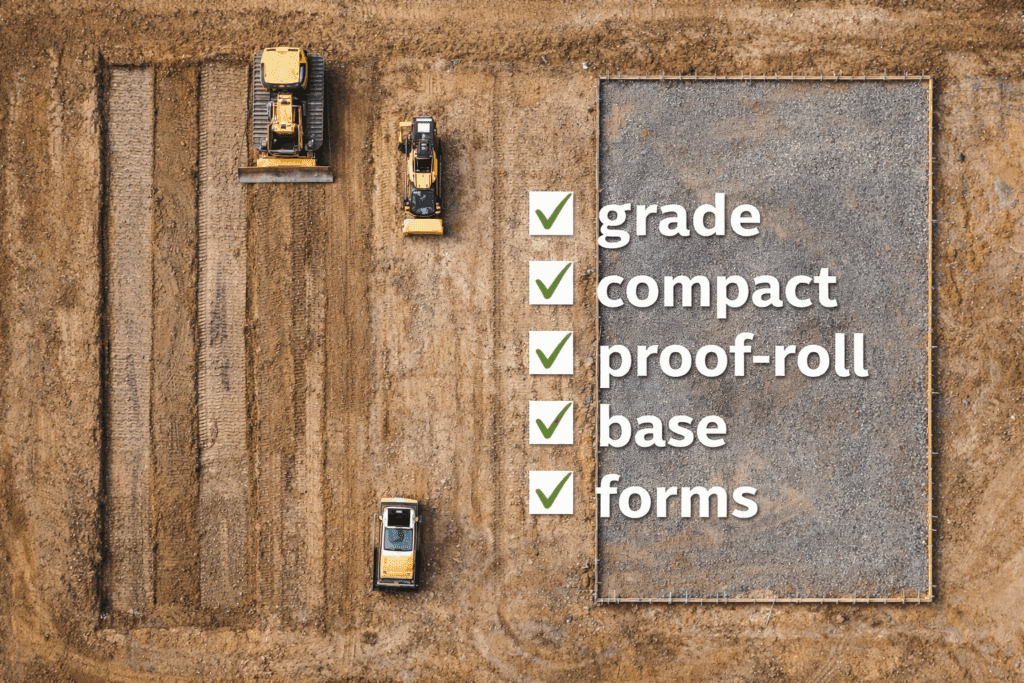
Commercial site prep often starts with excavation—removing topsoil, organic material, unsuitable soils, and any debris that can’t support loads. It can also involve cut and fill to bring the site to design elevations. This is where equipment work like dozers, excavators, and skid steers set the project up for correct base depth and consistent support.
Cut/fill work matters because base thickness depends on having room for it. If the site is not excavated deep enough, base gets “value engineered” down to make the numbers work, and the slab ends up sitting on less support than intended. If the site is over-excavated or filled with poor material, the slab may settle later.
A professional site prep plan considers the sequence: excavation to proper depth, subgrade prep, base installation in lifts, compaction testing, then final grading before forms go in. When these steps are skipped or compressed, problems show up later as settlement, cracks, and drainage issues.
Compaction: the step you can’t see, but you’ll feel forever
Compaction is the process of densifying soil and base material so it can support loads without shifting. It’s not just driving over the ground with equipment. Proper compaction means working material in lifts, controlling moisture content, and using the right compaction equipment for the material type.
Compaction is where commercial sites get into trouble because it can be inconsistent. Utility trenches are a common culprit. If a trench is backfilled without proper compaction in layers, it becomes a soft strip that settles. That settlement shows up as cracks and dips across slabs and pavements later. Another issue is working too wet or too dry. Material moisture has to be in a workable range to compact correctly. In South Dakota, spring thaw and fall rains can make moisture management a full-time job.
Compaction isn’t just about preventing settlement. It also supports drainage and helps prevent pumping—when water under a slab causes fines to move and base material to shift under traffic. Pumping can destroy joints and edges over time.
On well-managed projects, compaction is verified through testing or proof-rolling methods so soft zones are identified and corrected before concrete is placed. That’s a big reason high-quality commercial work lasts longer.
Base installation: crushed aggregate is the slab’s real support system
Base is the engineered layer between the subgrade and the concrete or asphalt. It’s usually crushed aggregate installed in lifts and compacted to create a consistent platform. Base is where loads are distributed. A good base reduces settlement, reduces slab movement, and supports uniform performance across the site.
Base thickness and type depend on the project. Heavy-use drive lanes and truck areas often require more robust base than light-use parking stalls. Sidewalks and equipment pads may have different requirements. What matters is that base is installed correctly: in layers, compacted, and graded to the right elevations so the slab thickness remains consistent.
Base also plays a major role in drainage. A properly designed site moves water away from structures and prevents saturation under slabs. If base becomes waterlogged, freeze-thaw cycles can heave and move sections. Even the strongest concrete doesn’t like a wet, unstable support layer.
Utilities and coordination: the hidden complexity under commercial slabs
One of the biggest reasons commercial site prep gets complicated is utilities. Storm, sanitary, water lines, electrical conduits, gas, communications, and site lighting all create conflicts with grading and subgrade stability. Every trench is a disruption. Every crossing is a potential settlement point if not handled correctly.
Good site prep coordination means utilities are planned in sequence and the site is restored properly after installation. It also means knowing where sleeves, stub-ups, and crossings need to go before the slab is placed. The most expensive fixes are the ones discovered after concrete is poured.
On commercial projects, site prep teams often coordinate with survey staking to confirm elevations and alignments. That helps ensure the site matches design intent, especially around drainage structures and building interfaces.
Erosion control and keeping the site compliant
Commercial site prep in South Dakota often requires erosion and sediment control measures. These can include silt fence, inlet protection, construction entrances, stabilized staging areas, and temporary drainage routing. The goal is to prevent sediment from leaving the site and to keep the project compliant with requirements.
Erosion control matters for more than compliance. It keeps your base clean and functional. A base layer contaminated with mud and fine sediment loses performance. If trucks track mud across base areas, compaction and grading can be compromised, leading to uneven support later.
Clean site management is a quality factor. It helps everything stay on schedule and keeps your base and subgrade in the condition you paid for.
Timing and weather: South Dakota makes schedule part of site prep
Weather isn’t an excuse—it’s a planning variable. South Dakota projects deal with spring thaw, heavy winds that dry surfaces fast, summer storms, and fall temperature swings that change how materials behave.
Moisture management is a major part of site prep. Too wet and you can’t compact properly. Too dry and you can’t achieve density without reworking. Smart scheduling and staging reduce rework and help keep the project moving without cutting corners.
This is also why the best commercial teams don’t rush to pour just to “get it done.” A slab poured on a poorly prepared base isn’t a win. It’s a future repair bill.
What owners should look for in a site prep scope
If you’re reviewing bids or scopes for commercial flatwork or site development, look for clear language about subgrade prep, excavation depth, base thickness, compaction methods, drainage grading, and utility coordination. Vague scopes lead to vague outcomes—and vague outcomes often become change orders when the real work becomes unavoidable.
A good site prep plan doesn’t just say “grade and compact.” It communicates the approach to building a stable platform, managing drainage, and preventing settlement. That clarity protects your budget and your long-term maintenance costs.
The bottom line: the best concrete starts with the best ground
Commercial site prep is the part of the project most people never notice—until it’s missing. When the site is properly graded, compacted, and built with a stable base, concrete flatwork becomes far more durable, drainage problems are minimized, and winter freeze-thaw cycles become less destructive.
If you’re planning commercial concrete, parking lots, sidewalks, drive lanes, or equipment pads in South Dakota, WagCo Construction can help you evaluate your site, plan the prep correctly, and build a foundation that supports long-term performance—not just a successful pour day.