
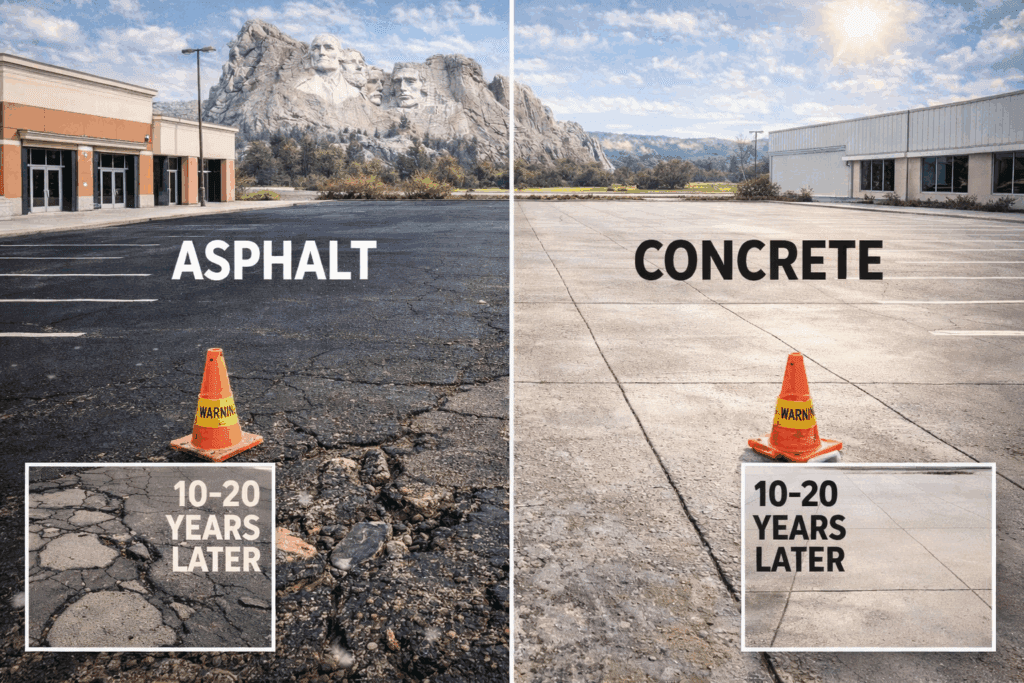
Concrete vs Asphalt for Commercial Lots in South Dakota: Which Wins Over 10–20 Years?
If you’re pricing a new commercial parking lot in South Dakota, it’s easy to get stuck on the upfront number. Asphalt often comes in cheaper at the start, while concrete typically costs more to install. But the real decision isn’t which surface is cheaper today—it’s which surface costs less to own over the next 10 to 20 years when you factor in maintenance, repairs, downtime, and how South Dakota weather actually treats pavement.
Both asphalt and concrete can be the “right answer” depending on your site, your traffic, and how you operate. A retail lot with constant turning traffic has different needs than a warehouse drive lane with delivery trucks. A clinic that can’t lose parking for a week has different priorities than a back-of-house service yard. And in South Dakota, freeze-thaw cycles and winter maintenance add pressure that many generic comparisons leave out.
This guide breaks down the differences the way a contractor and property owner should look at them: durability, maintenance realities, snow removal impacts, and lifecycle cost—so you can choose the surface that fits your business, not just your budget line.
Why the “cheapest bid” is rarely the cheapest lot
A parking lot isn’t just a surface. It’s a system made up of subgrade, base, drainage, edges, joints or seams, and the wear layer that takes abuse every season. If you only compare cost per square foot, you might miss the factors that drive the real cost of ownership: how often the lot needs work, how disruptive that work is, and how quickly small problems turn into big ones in a freeze-thaw climate.
In South Dakota, water is the enemy for both surfaces. Water that infiltrates and then freezes expands, pushing materials apart. Water that ponds creates ice and accelerates breakdown. Water that sits along edges, seams, and joints creates early failures. A surface choice that works well in a warm climate may behave very differently here if drainage and base aren’t handled correctly.
How asphalt behaves in South Dakota over time
Asphalt is flexible, which can be a benefit in a climate where the ground moves and temperatures swing. That flexibility can help it tolerate minor shifts without immediately cracking the way rigid materials can. Asphalt can also be installed and repaired relatively quickly, which makes it attractive for projects that need faster turnaround.
The tradeoff is that asphalt is more vulnerable to aging and oxidation. Over time, asphalt loses oils and becomes more brittle, especially with UV exposure and temperature extremes. Once it becomes brittle, it cracks more easily. Those cracks allow water infiltration. Water infiltration leads to freeze-thaw damage. Freeze-thaw damage leads to potholes, raveling, edge breakup, and larger failures.
This is why asphalt lots often look great early and then decline quickly if maintenance isn’t consistent. In commercial settings, it’s common for maintenance to get delayed—because business is busy, budgets are tight, or it “doesn’t look that bad yet.” Unfortunately, asphalt rewards proactive maintenance and punishes neglect.
If you choose asphalt for a South Dakota commercial lot, the best results usually come from treating maintenance as a planned operating cost, not a surprise repair.
How concrete behaves in South Dakota over time
Concrete is rigid and durable. It resists rutting, handles heavy loads well when designed properly, and performs strongly in high-turn areas where asphalt can deform under repeated turning tires. Concrete also doesn’t soften in heat the way asphalt can, and it often holds its shape better over time when the base and joints are done right.
Concrete’s tradeoff is that it requires more deliberate planning at installation. Joint layout matters. Finishing and curing matter. Drainage matters. If concrete is placed without proper jointing or without proper curing—especially in shoulder seasons—it can crack and its surface can become more vulnerable to scaling. Concrete can also be more expensive to repair in isolated spots compared to quick asphalt patching, depending on the scope.
That said, concrete is often chosen when owners value long-term performance and reduced frequency of major maintenance cycles. It’s common to see concrete used strategically in the most abused zones—entries, dumpster pads, loading areas, drive lanes—and asphalt used in lower-stress parking stalls. That kind of hybrid approach can provide a strong balance of cost and durability.
Freeze-thaw performance: what actually matters for both surfaces
Owners often ask which material “handles freeze-thaw better.” The honest answer is that both materials can fail in South Dakota if the system is wrong—and both can succeed if the system is right.
For asphalt, the key freeze-thaw threat is water infiltration through cracks and seams. Once water gets into the base and subgrade, freeze cycles create movement and voids, and the asphalt surface loses support. Potholes and breakup often follow.
For concrete, the key freeze-thaw threat is water entering the surface pores and freezing inside the slab, especially when de-icing salts are used. That’s where air entrainment, finishing discipline, and curing practices become critical. Concrete also needs proper drainage so water doesn’t sit and repeatedly saturate the slab.
In both cases, drainage and base prep do more to determine performance than the surface choice alone. A well-drained lot with a stable base and proper slope will outperform a poorly drained lot regardless of whether it’s asphalt or concrete.
Snow removal and de-icing: the hidden cost driver
South Dakota parking lots aren’t maintained gently. They are plowed, scraped, and salted. That reality should influence your decision.
Asphalt can be scraped and plowed, but aggressive plowing can catch edges and surface imperfections, especially if the lot develops low spots. Over time, plowing can accelerate raveling and edge damage when the surface weakens.
Concrete can handle plowing well when joints and edges are built correctly, but it can be more susceptible to surface scaling if de-icing salts are overused on a poorly cured slab. Concrete also needs thoughtful jointing so plows don’t catch uneven edges at faulted joints. If the base and jointing are right, concrete can be very resilient under plowing. If they’re wrong, joint edges can become maintenance points.
De-icing salts are hard on both systems. The goal is reducing ponding and keeping water moving so you’re not feeding the lot constant moisture that freezes and thaws. Lots that drain well tend to survive winters better regardless of surface.
Traffic type matters more than most people admit
A commercial lot isn’t just “cars.” Many South Dakota businesses have regular delivery trucks, service vehicles, or heavier equipment moving through. Turning loads are especially harsh. Think of trash trucks, box trucks, and delivery vans turning tight at a dumpster enclosure or loading zone.
Asphalt tends to struggle more with high-turn, high-load areas over time. You can see deformation and surface wear where tires pivot and grind. Concrete tends to excel in those high-abuse zones, which is why many owners choose concrete for aprons, approaches, dumpster pads, and drive lanes—even when they choose asphalt for the rest of the lot.
If your property has frequent truck traffic or high-use service zones, a mixed design often makes sense. You get asphalt’s lower upfront cost for large open areas and concrete’s durability where it matters most.
Maintenance cycles: what you should realistically expect
Asphalt typically requires a maintenance plan to hit its best lifecycle cost. That plan often includes crack sealing, periodic sealcoating, patching, and eventual resurfacing or overlay depending on conditions. If that maintenance is done consistently, asphalt can be cost-effective and perform well. If it’s delayed, failures accelerate and costs rise.
Concrete typically requires less frequent “surface maintenance” but may involve joint maintenance, isolated repairs, and occasional sealing depending on exposure and owner preference. Concrete tends to be more about doing it right upfront and then managing it intelligently over time.
The biggest difference is that asphalt’s success is closely tied to ongoing maintenance discipline. Concrete’s success is more closely tied to proper design, placement, and curing at installation.
Downtime and disruption: a real business cost
A major factor owners underestimate is disruption. If your lot needs frequent repairs or resurfacing that closes parking and changes traffic patterns, that affects tenants, customers, and daily operations. Retail centers and medical sites feel this especially hard.
Asphalt repairs can often be done quickly and phased, but resurfacing and overlays still require planning, closures, and cure time. Concrete repairs can be more disruptive when full slab replacement is needed, but a well-built concrete system can reduce how often you face major interventions.
If your business cannot tolerate frequent closures, choosing a system with fewer major cycles can be worth paying more upfront.
A practical way to choose: match the surface to your priorities
If your priority is the lowest initial cost and faster installation, asphalt often wins upfront. It can be a smart choice for large lots with lighter traffic where the owner is willing to follow a maintenance schedule.
If your priority is long-term durability in high-use zones, reduced frequency of major resurfacing, and better performance under heavy loads and turning, concrete often provides stronger long-term value—especially for drive lanes, approaches, dumpster pads, and loading areas.
For many South Dakota commercial properties, the best answer is a hybrid approach: concrete where abuse is highest, asphalt where area is large and traffic is lighter. This can stabilize lifecycle cost without forcing an all-or-nothing decision.
The decision that matters most: drainage and base
No matter which surface you choose, the most important investment is what’s underneath and how water moves across the site. Good grading, proper base thickness, stable compaction, and smart drainage design prevent ponding, reduce water infiltration, and extend the life of both asphalt and concrete dramatically.
A lot that drains correctly and has a strong base can outperform a cheaper surface choice on a weak base every time. If you want a parking lot that wins over 10–20 years in South Dakota, build the system right first, then choose the surface that fits your traffic and budget.
If you’re planning a new commercial lot—or you’re deciding whether to repair, resurface, or rebuild—WagCo Construction can help you evaluate traffic patterns, winter maintenance realities, drainage, and lifecycle cost so you can choose the surface that makes the most business sense in South Dakota.