
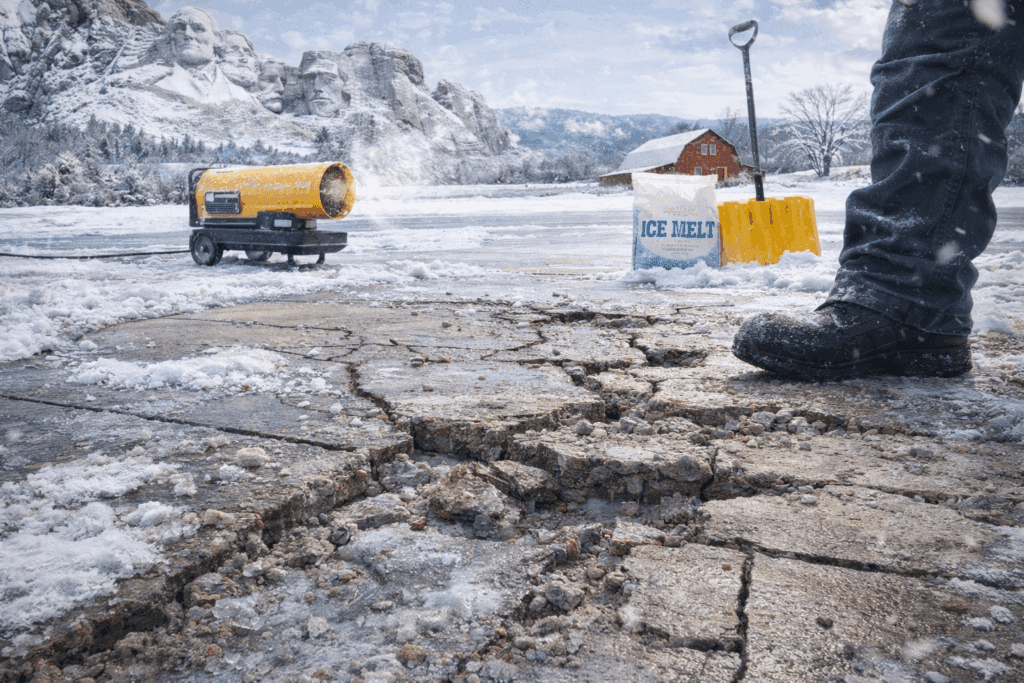
Freeze-Thaw Damage: How South Dakota Businesses Can Prevent Spalling, Scaling, and Cracking
South Dakota concrete doesn’t usually “fail all at once.” It wears down in a pattern. A slab looks fine for a couple years, then the surface starts flaking like it’s peeling. Corners chip and pop. Joints begin to crumble. Cracks widen, water sits where it shouldn’t, and every winter speeds up the damage. Property owners often assume this is normal aging, but most freeze-thaw damage is preventable when the concrete is designed, placed, and maintained for the climate.
If you manage a commercial property in South Dakota—an office building, retail site, industrial yard, multi-family complex, or agricultural facility—freeze-thaw performance matters as much as strength. The goal isn’t simply pouring concrete that hardens. The goal is pouring concrete that survives years of moisture, snowmelt, salt, and repeated temperature swings without turning into a maintenance problem.
This guide breaks down what freeze-thaw damage really is, why it happens, and what you can do to prevent spalling, scaling, and cracking on commercial concrete in South Dakota.
What freeze-thaw damage looks like in real life
Freeze-thaw damage shows up in a few common ways, and each one points to a different weakness in the slab system.
Scaling is the most common. It looks like the top layer of concrete is shedding—thin flakes breaking loose until the surface becomes rough and patchy. You’ll often see it in sidewalks, entries, and parking areas where snow sits and salt is used. Scaling isn’t just cosmetic. Once the surface opens up, it absorbs more water, and every freeze cycle pushes the deterioration deeper.
Spalling tends to be more aggressive. It shows up as chunks breaking loose, especially at edges, corners, and joint lines. Spalling often accelerates where snowplows strike, where vehicles turn hard, or where water repeatedly pools and freezes near an edge. A small spall becomes a bigger spall because the slab edge is now exposed and weaker.
Cracking is the one everyone notices, but it’s also the most misunderstood. Concrete cracks, even when it’s done correctly. The problem is uncontrolled cracking, widening cracks that allow water to penetrate, and cracks caused by movement below the slab. In South Dakota, movement and moisture are constant enemies. When water gets under a slab and freezes, it expands and can lift sections. When it thaws, the base can soften and settle. The result is uneven slabs, trip hazards, and joints that begin to break down.
The real culprit is almost always moisture
Freeze-thaw damage is rarely “just cold.” Cold by itself doesn’t destroy concrete. Water does.
Concrete is porous. Water can enter through the surface, through microcracks, and through edges and joints. When that water freezes, it expands. If the concrete doesn’t have the right internal structure to handle that expansion, pressure builds inside the surface layer and literally breaks it apart from within. That’s why you can see flaking and spalling even when the slab looked perfect at the time of installation.
Moisture also becomes a problem underneath the slab. Poor drainage, downspouts dumping near concrete, flat grades that pond, and subgrades that hold water create the conditions for heaving, settlement, and joint failure. If water has nowhere to go, it will freeze where it sits, and concrete will pay the price.
Why South Dakota’s freeze-thaw cycles are especially tough on flatwork
In many climates, winter stays consistently cold. South Dakota winters often shift back and forth. Daytime thaw, nighttime freeze. Meltwater runs, refreezes, runs again. That cycle can happen dozens of times over a season, especially in shoulder months. This repeated transition is brutal on concrete because it keeps feeding the slab with moisture while constantly creating expansion pressure.
Add de-icing salts to the mix, and you increase the problem. Salts pull moisture into concrete pores and can worsen surface scaling when the slab isn’t properly cured, properly air-entrained, or properly protected early in its life. High-traffic commercial sites can see this faster because tires, foot traffic, and plows abrade the surface and push water deeper.
Air-entrained concrete is not optional for exterior South Dakota work
If you want exterior concrete that survives South Dakota winters, air entrainment needs to be part of the mix design. Air entrainment creates a network of microscopic air bubbles inside the concrete. Think of them as expansion chambers. When water in the concrete freezes and expands, these bubbles provide space for that pressure to dissipate instead of tearing apart the paste at the surface.
Without proper air entrainment, concrete is far more likely to scale and spall in freeze-thaw climates, especially when salts are introduced. This is why exterior commercial slabs should be specified appropriately, tested appropriately, and placed by crews who understand what affects air content. Some practices that seem “helpful” on the jobsite—like adding water to the mix—can reduce durability and increase freeze-thaw risk.
If you’re a property owner, you don’t need to memorize technical specs, but you should expect your contractor to be confident and specific about exterior mix requirements for South Dakota, including air entrainment considerations.
Finishing mistakes can ruin a durable mix
One of the most frustrating realities of freeze-thaw damage is that you can have a good mix and still end up with a weak surface if finishing is mishandled.
Concrete bleeds water as it sets. If a crew starts finishing before bleed water has dissipated, they can trap water under the surface. If they overwork the slab, they can bring excess paste and water to the top. If they add water to “make it easier to close,” they dilute the surface layer. That top layer becomes weaker, more porous, and more vulnerable to freeze-thaw cycling. The slab may look smooth at first, but the surface can begin flaking after a couple winters.
Exterior commercial concrete in South Dakota also needs the right finish for safety. Broom finishes are common for sidewalks and exterior areas because they provide traction. A hard trowel finish can be slippery when wet or icy and is often better suited for interior floors where traction requirements differ. Finish selection doesn’t just affect appearance—it affects safety, maintenance, and performance.
Curing is the hidden step that determines long-term durability
Curing is where concrete builds strength and tightens up its surface. It’s also one of the easiest steps to skip if a project is rushed or if the scope isn’t clear.
Proper curing helps reduce surface porosity, improves abrasion resistance, and supports strength development. In freeze-thaw climates, curing is especially important because a well-cured surface resists water penetration better, which reduces the amount of water available to freeze inside the slab. In other words, good curing makes the slab harder for winter to destroy.
On commercial sites, curing may involve curing compounds, wet curing methods, protective coverings, or combinations depending on weather and schedule. When pours happen in spring or fall, cold-weather protection becomes part of curing. Overnight temperature drops can damage young concrete, and once that surface is compromised early, freeze-thaw deterioration becomes easier later.
If you’re comparing bids for commercial flatwork in South Dakota, it’s a good sign when curing and seasonal protection are spelled out clearly. It’s a warning sign when they’re not mentioned at all.
De-icing salts and snow removal can accelerate damage
Most commercial properties need to manage ice. But de-icing chemicals can contribute to scaling and surface breakdown, especially on newer slabs or slabs that weren’t properly cured.
One of the biggest mistakes owners make is applying aggressive de-icers too early on new concrete. Another is relying on salt as the only solution when sanding or alternative traction methods could reduce chemical exposure. Even when salts are necessary, good drainage and proper slab design reduce how much salty water sits on the surface and seeps into the concrete.
Snowplows also cause damage that looks like freeze-thaw spalling. Repeated blade strikes at edges, corners, and joints can start small breakouts that worsen each season. This is especially common on dumpster pads, approaches, and tight turn areas where plows hit the same locations again and again. Designing edges correctly and protecting vulnerable zones can reduce this.
Drainage is the #1 design factor owners can control
Concrete can handle cold. It can’t handle standing water that freezes repeatedly.
Poor drainage shows up as ponding water in low spots, flat sidewalks that hold meltwater, downspouts discharging onto slabs, and grades that push water into joints. Over time, ponding increases because small settlement changes slope patterns, which holds more water, which increases freeze-thaw damage, which creates more low spots. It becomes a loop.
Good drainage is built at the start. That means proper grading, crowns where needed, controlled runoff, and sometimes drain systems like trench drains or catch basins in problem areas. It also means thinking beyond the slab itself. Landscaping, downspouts, and adjacent pavement all influence where water goes.
If you’re planning new commercial concrete in South Dakota, drainage is not an “extra.” It’s part of durability.
Sealers can help, but they’re not magic
A quality sealer can reduce water absorption and help protect concrete from salts and surface wear. But a sealer can’t fix poor finishing, poor curing, or drainage problems. Sealers work best as part of a complete plan: good mix design, good finishing, good curing, correct slopes, and responsible maintenance.
Sealer success depends on applying it at the right time, choosing the right product for the environment, and reapplying on a schedule based on traffic and exposure. Some commercial owners benefit from sealing high-exposure zones like entries, sidewalks, and service areas, especially where salts are unavoidable.
What to require in your commercial concrete scope for South Dakota winters
If you want concrete that survives freeze-thaw cycles, your scope should reflect the realities of South Dakota weather. Exterior mix design needs to be appropriate for freeze-thaw exposure. Finishing practices should protect the surface layer instead of weakening it. Curing and seasonal protection should be included, not implied. Jointing should be planned, and drainage should be designed so water doesn’t sit and soak.
The best bids aren’t the ones with the most vague assurances. They’re the ones that show you the plan. When a contractor can explain how they’re protecting your slab from moisture, movement, and seasonal swings, you’re usually talking to someone who builds for long-term performance.
When to repair, when to replace, and when to address the cause first
If your concrete already shows freeze-thaw damage, the right solution depends on what’s happening underneath and around it.
Minor surface scaling might be manageable in some cases, but if the slab is still absorbing water and sitting in ponded meltwater, the scaling will likely return. Spalling at edges and joints often signals a combination of traffic impact and moisture exposure, and patching without addressing drainage and joint behavior tends to be temporary. If slabs are heaving, settling, or rocking, base and drainage issues need to be evaluated before surface fixes will last.
A professional assessment should focus on cause, not just symptoms. In many cases, improving drainage, correcting grades, and adjusting maintenance practices can extend the life of surrounding slabs even if some replacement is needed in high-damage zones.
Concrete that lasts through South Dakota winters starts before the pour
Freeze-thaw damage isn’t inevitable. It’s usually a predictable outcome of moisture exposure combined with weak surfaces, poor curing, or poor drainage. When commercial concrete is designed and installed for South Dakota conditions—with proper air entrainment, disciplined finishing, solid curing and protection, smart jointing, and drainage that moves water away—it holds up dramatically better over time.
If you’re planning new commercial flatwork or evaluating repairs for existing concrete, WagCo Construction can help you identify the real risk factors and build a plan that prevents repeated winter damage instead of chasing it every spring.