
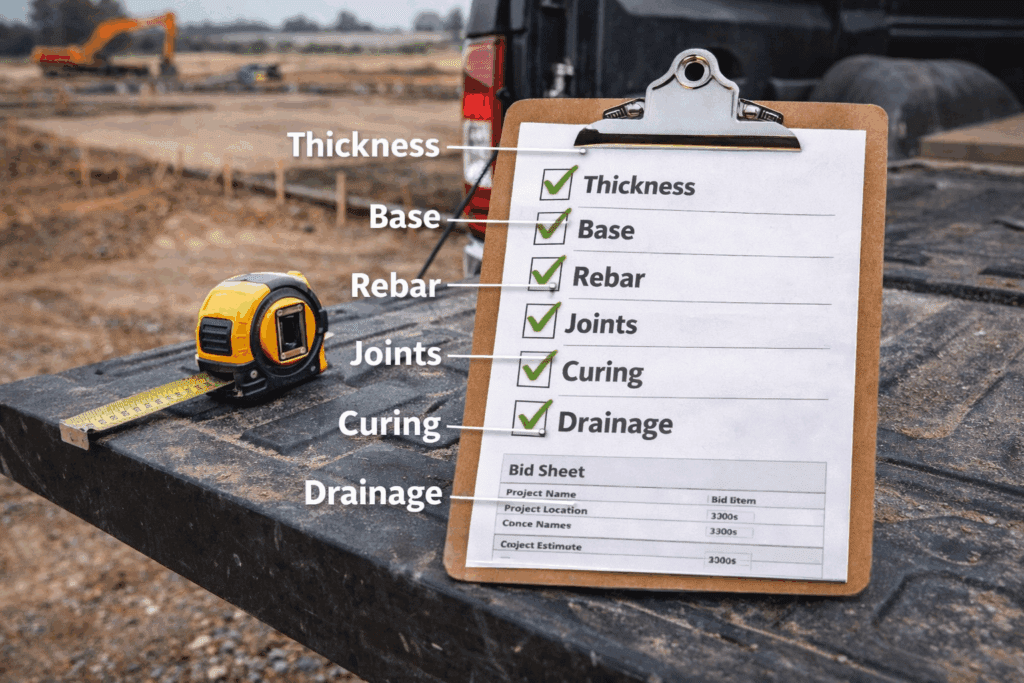
How to Bid and Compare Commercial Concrete Quotes in South Dakota: An Apples-to-Apples Checklist
Commercial concrete bids can be confusing on purpose—or confusing by accident. Either way, property owners end up in the same spot: two proposals with different totals, different wording, and just enough detail to make it hard to know what you’re actually buying.
If you’re pricing concrete sidewalks, pads, aprons, parking lots, or commercial flatwork in South Dakota, the lowest number isn’t automatically the best value. Concrete is one of those scopes where missing details become change orders later, and “included” can turn into “not included” the moment excavation reveals soft soils or the site needs more base than someone assumed.
This post gives you a practical way to compare bids like a contractor would—without needing to be an engineer. It’s written for real business owners, facility managers, and property managers who want a clean, readable checklist that protects the budget and leads to better long-term performance.
Why commercial concrete quotes vary so much in South Dakota
Concrete isn’t priced like a retail item. It’s priced like a system. The slab you see depends on the base you don’t see, the drainage you may not notice, the reinforcement you’ll never touch, and the finishing and curing steps that determine whether the surface holds up through freeze-thaw cycles.
Most bid gaps come down to scope assumptions in a few areas: thickness, base preparation, reinforcement, joint planning, site access, demolition, and seasonal protection. A contractor who includes those details may look more expensive up front. A contractor who leaves them vague may look cheaper until the job starts.
South Dakota adds extra pressure because weather and freeze-thaw conditions punish shortcuts. Ponding water and soft subgrades don’t just create minor issues here—they create long-term failures.
The simplest rule: compare scope before you compare price
Before you look at totals, pull each quote into the same format. You’re trying to answer one question: are these contractors building the same thing?
If one quote includes demo and disposal and another doesn’t, the lower quote isn’t lower—it’s incomplete. If one quote includes thicker concrete in heavy-use zones and another assumes uniform thin sections, you’re not comparing the same slab. If one quote includes base correction and compaction language and the other doesn’t mention base at all, that’s not a price difference. That’s a quality and risk difference.
A good comparison process is mostly about forcing clarity.
Start with this: what areas are included and what areas aren’t
Commercial concrete quotes often use broad terms like “flatwork” or “parking lot concrete.” Make sure the scope lists the actual areas being built.
For example, a parking lot project might include drive lanes, parking stalls, sidewalks, approaches, dumpster pads, curb sections, and ADA ramps. It might also include only part of that list. If one contractor assumed the dumpster pad is part of the job and another didn’t, your totals will naturally diverge.
Readability tip: ask the contractor to define the job in plain language. A solid contractor can summarize the scope without hiding behind jargon.
Confirm thickness and load assumptions in plain terms
Concrete thickness should match use. Sidewalks and storefront walkways are not the same as truck aprons or dumpster approaches. Yet many bids lump everything into one line item.
Ask each bidder to specify thickness by area. If they can’t, that’s a concern. If they can, you’ll immediately see why quotes differ.
If your site will see delivery trucks, trash trucks, forklifts, or frequent turning loads, bring that up early. Many failures happen because owners assume the contractor “knows,” but the contractor is pricing based on a light-duty assumption unless otherwise stated.
This is especially important in South Dakota because heavy loads plus freeze-thaw movement can destroy underbuilt sections faster than expected.
Base prep is where most “cheap” bids become expensive
Base prep is the most common missing scope item in commercial concrete quotes, and it’s also one of the biggest drivers of long-term performance.
A complete quote should mention subgrade preparation and base installation in some form. Look for language about excavation depth, base thickness, compaction, and addressing soft or unsuitable soils.
When base prep is vague, contractors sometimes price for best-case conditions. Then, once the site is opened up, you get a change order for additional excavation, additional base, or subgrade correction. Sometimes the site genuinely needs it. Sometimes it was predictable and simply wasn’t included in the “cheap” number.
A clean way to ask is: what is included for subgrade prep and base, and what happens if soft spots are found?
Reinforcement: make sure it’s specified, not implied
Rebar, wire mesh, and fiber reinforcement can all be useful, but “includes reinforcement” is not a spec.
Ask what reinforcement is included, where it’s included, and how it will be placed. This matters because reinforcement that ends up in the wrong position can provide far less benefit than owners assume.
If one quote includes rebar in heavy-use areas and the other includes only fiber, that can be a legitimate reason for a price difference. Neither is automatically “right” without knowing the application, but the difference needs to be visible in the scope so you’re not guessing.
If you want a quick red flag: a quote that says “mesh included” without anything else can be a sign of generic pricing.
Joints and layout: the detail that prevents random cracking
Concrete will crack. That’s not the issue. The issue is whether it cracks where you want it to.
A professional quote should acknowledge jointing—control joints, isolation joints, and how joint layout is handled. It doesn’t need to include a full engineering drawing, but it should show that the contractor plans joints intentionally instead of treating them as an afterthought.
South Dakota’s temperature swings and freeze-thaw cycles make joint behavior more important. If joints are too far apart, cracks can wander. If isolation joints are missed at fixed objects, stress cracks can show up. If joint edges aren’t protected and the base isn’t stable, joint faulting can develop.
A simple question that keeps things readable: how will you prevent random cracking and protect joint performance over time?
Curing and seasonal protection should be in the scope
Curing is one of the most skipped steps in low-detail proposals, and it has a real impact on surface durability—especially in freeze-thaw climates.
If your project is scheduled in spring or fall, ask what the cold-weather plan is. A good contractor will talk about temperature thresholds, blankets or protection methods, scheduling strategy, and curing approach.
In South Dakota, a slab that isn’t cured and protected properly can start scaling and flaking after a few winters, even if everything looked fine at installation.
If you want to keep this easy: ask if curing is included, and ask what method they use on commercial work.
Access, phasing, and keeping your business open
Many commercial concrete jobs happen at occupied sites where entrances must remain open, parking must be maintained, or tenants must continue operations.
If your lot or sidewalks need to stay functional, phasing is part of the job. Some bids include phasing and temporary access. Some assume a full closure. That alone can change labor and schedule significantly.
Ask each bidder how they’ll maintain access and safety during construction. If one quote includes traffic control, signage, and phased sequencing, it may be a more realistic number—even if it’s higher.
This is also a quality signal. Contractors who plan phasing well tend to manage commercial projects with fewer surprises.
Demo, removal, and disposal: the most common missing line item
If you’re replacing existing concrete or asphalt, make sure demolition and disposal are clearly defined. “Remove as needed” is not a clear scope. It should state what is being removed, how deep, and whether disposal fees are included.
If one quote includes full demo and another doesn’t, your totals aren’t comparable.
Also check whether sawcutting and protection of adjacent surfaces are included, especially near buildings and entrances.
Drainage: the long-term value item that doesn’t always show on bids
Drainage is a big deal in South Dakota. A lot that ponds water becomes a maintenance problem and an ice problem.
Your quote should reflect the grading plan, slope expectations, and how water will move away from the building and across the lot. If you’re adding new drains, trench drains, or adjusting downspout discharge, that should be spelled out.
A good contractor will talk about drainage early. A contractor who never mentions it is either assuming someone else is handling it or not thinking long-term.
The apples-to-apples checklist you can copy and paste
When comparing commercial concrete bids in South Dakota, make sure each quote clearly answers these questions in writing:
The scope states exactly what areas are included and excluded, and it matches your site plan and expectations.
Concrete thickness is specified by area, especially in heavy-use zones like drive lanes, dumpster pads, and loading aprons.
Base preparation is described, including excavation depth, base thickness, and compaction approach.
Reinforcement is specified with a clear material choice and placement plan.
Jointing is acknowledged, including control and isolation joints and who determines layout.
Finish type is defined for each area, especially exterior traction surfaces.
Curing and seasonal protection are included and appropriate for the project timing.
Demolition, removal, and disposal are clearly included when applicable.
Phasing and access planning are addressed if the site is occupied or must remain operational.
Drainage and grading intent are included so water doesn’t pond and ice doesn’t become a constant issue.
If a bid can’t answer these in plain language, you’re not getting a complete picture.
A good bid protects you from surprises
The best commercial concrete quotes don’t just tell you a price. They tell you what you’re buying, what’s included, what assumptions are being made, and how the contractor will handle predictable site realities—especially in South Dakota where moisture, freeze-thaw, and snow removal are constants.
If you want the most accurate, predictable number, ask for a site walkthrough and a scope that spells out base, drainage, thickness, reinforcement, jointing, curing, and phasing. That clarity is how you avoid change orders and avoid paying twice.
WagCo Construction can help you compare bids, refine your scope, and build commercial flatwork that performs long-term in South Dakota instead of becoming a repair cycle after a few winters.